

Pádraig Ó Tuama, a poet, theologian and faculty member at Yale Divinity School, was uninvited from the upcoming Writer’s Symposium by the Sea. The decision was made by Point Loma Nazarene University President Kerry Fulcher, due to specific lines in poems that he found theological problems with. The cancellation was made known to faculty on Tuesday, Oct. 27, but the decision was reversed later in the week, on the condition that Dean Nelson, professor of journalism at PLNU and director of the Writer’s Symposium by the Sea, explicitly ask him about the lines.
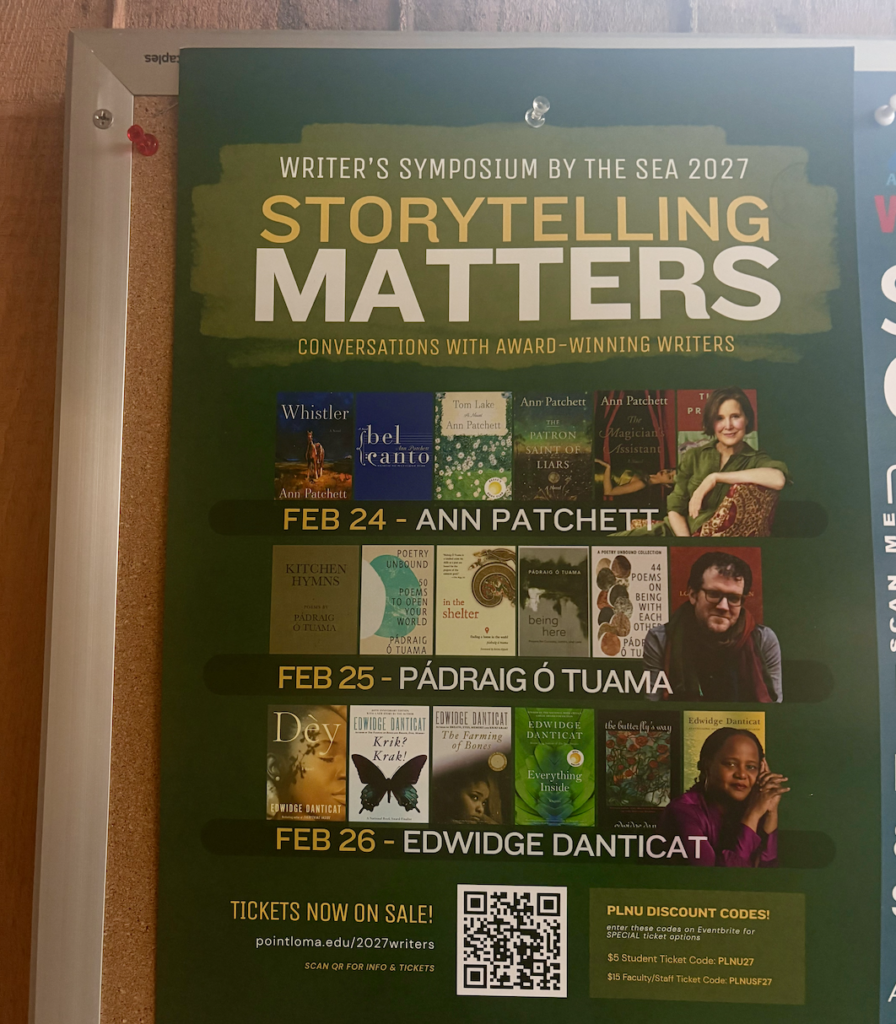
The Writer’s Symposium by the Sea is an annual event that brings well-known writers to PLNU to be interviewed by Nelson about their craft. This year, Nelson said he invited Ó Tuama because “he is a great poet whose art can elevate all of us.”
Nelson heard rumors for a few weeks that there were talks of uninviting Ó Tuama, but he said he dismissed them as “interesting, but not even plausible.” However, on Monday, Oct. 26, Nelson met with Provost and Chief Academic Officer G. James (Jim) Daichendt, who informed him that Fulcher had cancelled the invitation to Ó Tuama. In this meeting, Nelson said that Daichendt made it clear that the decision was solely made by Fulcher.
Nelson said he was angry with the initial decision, and met with Fulcher on Tuesday morning.
“[Fulcher] told me what he had decided and why and was not really open to discussion about it,” Nelson said.
Fulcher then explained his decision to PLNU faculty in a meeting on Wednesday.
“Kerry [Fulcher] told the faculty that his decision was almost entirely based on his reading of Pádraig’s poems and disagreeing with how he portrays Jesus in some of his poems,” said Katie Manning, a professor of writing at PLNU. “He thought that it was not theologically sound.”
Erin Reisler, a first year Masters in Writing student at Point Loma Nazarene University, said that it is important to understand that poetry is not nonfiction, nor is it necessarily the poet directly asserting an idea as truth. Rather, Reisler described it as an art of exploration. Nelson and Manning shared similar understandings of how poetry is interpreted.
“[Fulcher] picked out a few lines of Ó Tuama’s that he found problematic theologically and maybe even blasphemous.” Nelson said. “My feeling was, poetry is always metaphor, poetry is imagination and to read it literally would be a mistake. I had a very strong feeling that he consulted none of our experts at Point Loma, none of the people who teach poetry, none of the people who teach theology, he consulted none of them.”
Manning said the decision impacted her personally, and caused her to think about academic and artistic freedom within university settings. She defined poetry as a literary art form that works in countless ways to “get people to think about possibility.” To her, this decision represented a misreading of poetry’s function that she felt personally hurt by.
“What does it mean if I teach at a university that misunderstands the function of poetry and devalues poetry and poets?” Manning said. “I felt a complex mix of anger and hurt, and then I think I tried to swing toward hope that this could be reconsidered and that this decision could change.”
Manning, a poet herself, said she had not been consulted before the decision, but wished she had been, because she felt the cancellation of the invitation represented the university poorly.
“Although it appears that PLNU doesn’t value or understand poetry, that is not the case on the ground,” Manning said. “I think this is a misunderstanding by our president who has a background in biology and did not consult any of the LJWL faculty.”
After announcing the cancellation of the invitation to the faculty, Nelson said that some of the faculty in literature and theology reached out to Fulcher to have conversations about the decision. This included, Nelson said, Robbie Maakestad, a professor of Associate Professor of Writing and the program director of the Master’s in Writing program at PLNU, inviting Fulcher to a class on interpreting poetry and literature as metaphor.
In the midst of the cancelled invitation, Fulcher said that Nelson could host Ó Tuama off campus, as long as PLNU wasn’t giving him a platform, so they found the First United Methodist Church in Mission Valley who was willing to host the event. They contacted Ó Tuama’s representative who said he would still be willing to come to the interview.
On Thursday, however, Nelson received a phone call from Fulcher, who said he could host Ó Tuama on campus, as long as he brought up some of the writing points that Fulcher found problematic in the interview. Nelson agreed to this because he said he was already planning on asking about this topic in the interview. Ó Tuama will be coming to PLNU for the 32nd Writer’s Symposium by the Sea on February 25.
“If there’s a problematic topic, of course I’m going to engage it,” Nelson said “I don’t think Jesus is threatened by how we think about him, so I don’t know why we would be either.”
Manning has personally met Ó Tuama, and said that his work has prompted her to think about the humanity of Jesus more deeply, which she said has been valuable in her life. She said that these poems are likely not theological decrees, but rather art that prompts thinking.
“I value so much the work that he does as a poet, and I also value the work that he does as a peace maker,” Manning said. “It is such a variety of important things that he does and I think it would be a real disservice to our students to not have him here.”
Reisler said the change in decision came as a huge relief to her, because she said the decision to prohibit an author from coming to campus due to theological disagreements would have brought questions surrounding who is welcome and accepted on campus versus who is not. Reisler said the initial cancellation of the invite caused her and her cohort to have to think about censorship in writing and art in universities.
“I am thankful for the wisdom and humility of the president to engage with the community on this decision to hear out faculty and students and to allow a healthy discourse through visiting and guest speakers like Ó Tuama,” Reisler said.
During the initial decision to cancel the invitation, both Nelson and Manning said they received an immense amount of support from their colleagues. Manning said she received messages of support from faculty in every department across campus, which she called a “weird silver lining.”
“I have never, ever, felt the widespread support for the Writer’s Symposium the way I have in the last few days,” Nelson said. “I actually didn’t realize how important this was to so many people at Point Loma and to the community.”
The Point reached out to Fulcher for comment and has not received answers at the time of this publication.

 Grace Chaves