
Votes from the 2026 midterm elections are still being tallied across California, and although final results will not be certified for several weeks, projected outcomes in several major races and ballot measures could affect Point Loma Nazarene University students.
California voters had 14 statewide propositions on their ballots to consider, alongside races for state and local offices. While each outcome plays a role in shaping California’s government, several have particular implications for PLNU students, from financial aid to accessible housing access to local representation.
For more information about all of the local and statewide ballot measures and candidates can be found on Ballotpedia California 2026 Elections page or the CalMatters Voter Guide.
Governor
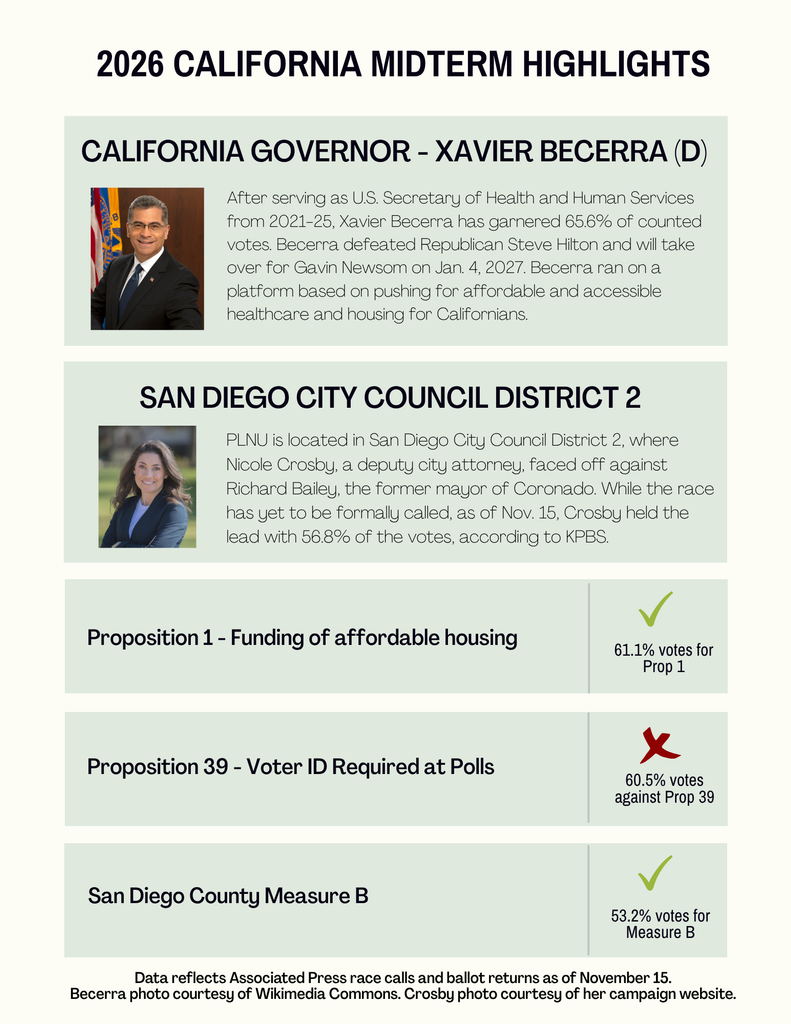
Xavier Becerra, a Democrat and former U.S. secretary of Health and Human Services, will be California’s next governor, according to the Associated Press. Becerra, who ran against Republican Steve Hilton, campaigned on expanding access to healthcare, affordable housing and, according to his campaign website, “fighting Donald Trump.”
Becerra will take office Jan. 4, 2027, and oversee the administration of the state’s executive branch. His responsibilities will include proposing the state budget, appointing judges and state agency officials and implementing state policies.
His proposed budget, which will be released in January, will include funding numbers for the California Student Aid Commission (CSAC). The Cal Grant program is part of the CSAC, and PLNU students who are California residents and qualify for Cal Grant funding can use the money to help pay for tuition.
City Council — District 2
PLNU is located in San Diego City Council District 2, where Nicole Crosby, a deputy city attorney, faced off against Richard Bailey, the former mayor of Coronado. While the race has yet to be formally called, as of Nov. 15, Crosby held the lead with 56.8% of the votes, according to KPBS.
One major focus of Crosby’s campaign was increasing short-term rental regulations. For this change to happen, she would need support from the whole city council. She also said she wants to make political engagement more accessible to local college students so their voices can be heard within the local government.
“It is very apparent that much of the voice that is heard in local government comes from individuals who have more time to do it,” Crosby said to The Point. “Which is typically not a student because some of the access to meetings and information is not catered to students.”
Proposition 1 — State Funding for Affordable Housing
Proposition 1 is projected to pass, with 61.1% of voters supporting the measure, according to CalMatters. Its passage would allow the state government to issue $11.25 billion in bonds for affordable housing programs.
Of that funding, $1.25 billion will be designated for the state’s veteran home loan program, which student veterans at PLNU may be eligible for. There is $350 million of the bill allocated for student housing, but it is for California’s public university systems.
Proposition 39 — Voter ID Requirements at the Polls
California voters rejected Proposition 39, which would have required all voters to present a government-issued ID when voting in person or provide the last four digits of a government-issued ID when voting by mail.
The measure’s rejection means the law will remain the same; voters still must verify their identity when registering to vote, but don’t have to bring a government-issued ID to the polls.
San Diego County Measure B
Measure B is projected to pass with 53.2% voter support, according to KPBS. If implemented, the measure would increase countywide sales tax by half a cent. PLNU students would see this addition on applicable purchases throughout San Diego county in April 2027.
The measure is projected to generate around $400 million in revenue annually. Up to 60% of the revenue can go toward providing access to affordable health care, nutrition and family services, up to 22.5% can go toward cleaning the Tijuana River Basin and up to 17.5% can go toward public safety services.

 Grace Chaves