

Dolores Huerta and the power of the collective
In light of Dolores Huerta’s passing on Oct. 28 at 96 years old, her life’s work and mission should be remembered as a long and consistent cheer to join forces against injustice. Huerta was a model community member — someone who inspired everyone who encountered her to question authority, protest injustice on any level and look out for each other.
When her students, who were children of farmworkers, walked into her classroom shoeless and hungry, Huerta decided she could not continue teaching them. Instead, she set out to begin a more than 60-year long career that would change farm work and agriculture in California forever and have a ripple effect in America. Thanks to her work, farmers and other workers not only had shoes for their children’s feet, but also dignity and control in their workplaces.
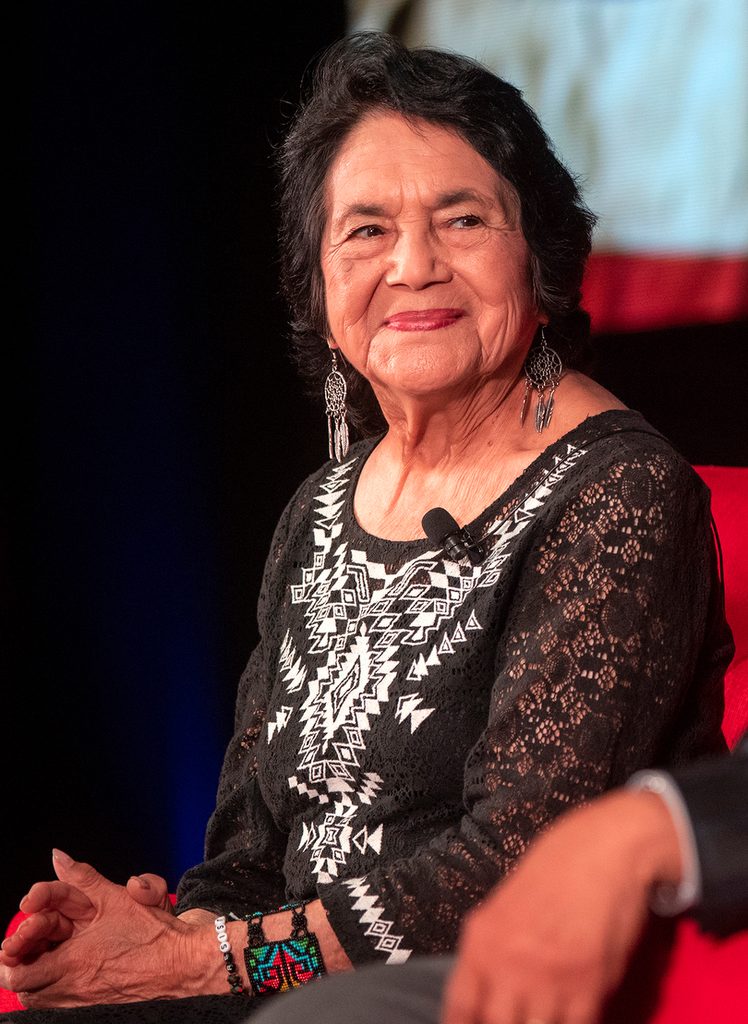
When Huerta quit her teaching job in Stockton, California, where she had been raised and had gone to college, she became involved in movements that she would stick to for the rest of her life. It was during this time that she co-founded the United Farm Workers in 1962, the nation’s oldest labor union for agricultural workers, with Cesar Chavez and Gilbert Padilla. Through this work she led protests and boycotts, improved California’s labor laws regarding working conditions, fought against pesticide use and so much more.
She was jailed over 20 times, and once hospitalized for several weeks after being beaten by police officers at a protest. While many assumed the decades of intimidation would slow or halt her activism, it only drove her forward.
Jamie Gates, a professor of sociology at Point Loma Nazarene University, witnessed Huerta’s resilient nature first hand at an event she spoke at.
“She comes along with this sheer strength of commitment,” Gates said. “She’s been literal energy — the wind in the sails of labor justice.”
Marshela Salgado is a PLNU alum, co-founder of non-profit SD United Youth Collective and executive minister and chief operation officer of University Christian Church in San Diego. She has looked up to Huerta for as long as she can remember.
“One of the most important things we can learn from her life is that change can come about with everyday, ordinary people,” Salgado said. “She was just an ordinary individual that chose to take a stand — that chose to organize people and make a difference.”
Huerta focused on “the collective”, the idea that everyone has to be a part of an active change for it to happen. Salgado says this is a vital part of any successful movement.
“We keep waiting for the next MLK to show up — that one person that is going to rally us and move us,” Salgado said. “That’s a figure, but behind figures are so many people working and moving. It’s all of us together.”
Earlier this year, Huerta came forward with sexual abuse accusations against Cesar Chavez, a secret she had kept for over 60 years. In a Facebook post, she claimed that she was “manipulated and pressured” by Chavez on two separate occasions, also including that “both sexual encounters with Cesar led to pregnancies.” Huerta said she kept the abuse private because she did not want it to overshadow the mission she was working towards.
“The farmworker movement has always been bigger and far more important than any one individual,” Huerta said in the post. “Cesar’s actions do not diminish the permanent improvements achieved for farmworkers with the help of thousands of people.”
Huerta’s courage to hold this burden for two thirds of her life is a testament to the strength of her belief in the movements that she worked towards. Belen Palomino Young, a second-year multimedia journalism major at PLNU emphasized the injustice of Huerta being overshadowed by Chavez, especially after the news of his abuse came out.
“She fought for the same group of people that Cesar Chavez did, and she also carried this secret her whole life,” Palomino Young said. “If it was up to me, I’d rename everything that’s named after him after her.”
Another witness to Huerta’s lasting influence in regular life is Carmen Cuevas, an associate professor of social work at PLNU, who heard Huerta speak at the San Diego Film Festival in March 2025. She has been a social worker for over two decades, and said Huerta was a huge part of her motivation to work with first generation families.
“She puts an emphasis on making sure it just feels like it’s all around you, in every single worker,” Cuevas said. “We all deserve it and we all should fight for it.”
Cuevas continued, reflecting on Huerta’s choice to come forward so late in her life about the abuse she endured in her 30s.
“The gift that she gave us in the end with her disclosure is that even someone that was so powerful needed a system to support her, too,” Cuevas said. “I hope that we understand that even though this icon was so powerful, she also needed grace and she also needed a village. We all do.”
Huerta gained recognition on great stages, including when she was awarded the Presidential Medal of Freedom by Barack Obama, when she helped instate the California Agricultural Labor Relations Act of 1975, when she championed the Delano Grape Strike and other nationwide produce boycotts and when she coined the iconic term “¡Si, se puede!” However, her work was truly about the everyday impact. The process it takes for food to get from the farm to the plate is a constant reminder of her influence. Most importantly, Huerta showed that progress can never be attributed to one person— behind every successful movement there is a community in unison.

 Nathan Gibbs