

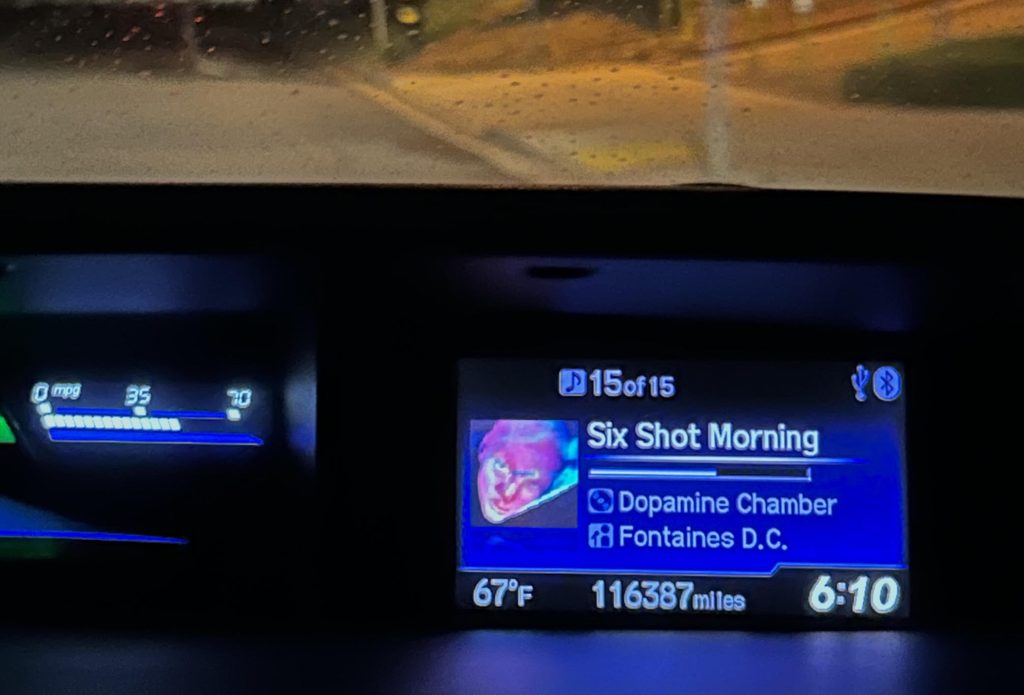
I often wake up in the early hours of the morning, before the sun even has a chance to introduce itself to the new day ahead. My ritualistic morning routine has become a tad monotonous, but variation is added when I hop into the driver’s seat of my car and play a random album I’ve yet to hear for my commute.
On one of these drives, the lucky draw was “Dopamine Chamber.” The newest album by the Irish rock band Fontaines D.C. engulfed the next 43 minutes of my otherwise average commute with something special. The previous album came out in 2024, so fans have been eagerly waiting for two years for something new, and “Dopamine Chamber” did not disappoint.
The title alone of the first song, “Six Shot Morning,” is enough to entice listeners. The opening 30 seconds of the song opened my eyes to what kind of album “Dopamine Chamber” would be. Blasting through my busted car speakers, “Six Shot Morning” is carried by a heavy electronic sound. The beat resembles a natural phenomenon called “singing lakes,” where frozen bodies of water crack and create beautiful acoustics and pings and whistles.
This new-age sound is then complimented by lead singer Grian Chatten’s saddened vocals. “Six shot morning, it’s a beautiful world / Sky’s gone crying on a beautiful world / Always.” Chatten chokes out these first verses, and provides a glimpse into how he feels about the current state of the world. Chatten has stated in interviews about the album that the world is a dystopia, where people are finding means to distract themselves. The lyrics eventually evolve with the growing instrumentation into “Melancholy hearts in emotion filming / Melancholy hearts in a motion film.” They are a recognition of how far the world has fallen and how Chatten believes that we, as its inhabitants, are having our deepest feelings always put on display in the digital age.
This hopeless introductory track is followed by “Marianne,” which at first listen sounds like it brings a happier tone based on the instrumental pieces. However its lyrics tell a story of a woman debating if she will allow herself to be taken by the same “dream fog” that her partner succumbed to. The chorus oozes into the listener’s ear, morphing into an almost seductive tone as the lyrics flow. The change resembles Marianne’s situation, where she is being tempted to accept this fog and is beckoned by a force that can help her disappear into this “cinematic feeling.”
The album brings together songs that don’t necessarily align in subject matter, but still work together musically. The third song, “Mimesis,” brings an overarching theme of the imitation of art and people, while the following track, “Happy For You,” is about moving on from someone. While the album tackles multiple themes, it also tackles multiple new instrumentation styles that stray away from the spoken-word style songs it has typically produced. Many songs on the album have darker guitar pieces with synthesizer-heavy soundscapes. Fontaines D.C. is adopting a completely different sound with the added instruments. The theme of dystopia and dread has not changed, but the manner in which they’re expressing themselves is new and wildly unique.
Following “Happy For You” comes one of my favorites on the album, “One Man.” Chatten sings, “Call me up any time that you wanna fly, yeah / Come and see me and I’ll show you where to float,” and ties in both the fog motif and the overarching theme of dread. This song focuses on how much weight that society can place on people’s shoulders. With this added, all-consuming pressure, escapism toward unhealthy means can look better than a person’s current condition. Perhaps this fog is dangerous, yet it just might be better than whatever the world has to offer to “one man.”
Marking the first-ever artist collaboration, “Where Is Gone?” continues the album with a beautiful duet with Spanish singer-songwriter Rosalía. Marking the first-ever artist collaboration, the track stands out from the rest of the album. It differs not only in sound, with the addition of a female voice working with Chatten’s, but also in theme — bringing a slight tinge of hopefulness in its lyrics. Although it deals with the idea of loss and grief, the lyric, “A certain man will come and tell you / That you’re not alone at all,” provides an illusion to a Christ-like figure that can offer hope, and nods to the band’s Catholic roots.
“You Miss Me,” “Japan” and “Intimate” conclude the 11 song adventure. Of the three, “Intimate” stands out with a gritty, dark electronic background that flows cyclically back into the opening song of the album. Its lyrics highlight the death of individuality, which sadly compliments the doom of “Six Shot Morning.” At the end of “Dopamine Chamber,” the listener finds themselves trapped in the dread of a crumbling world rather than ending on a positive note of redemption.
Fontaines D.C. wonderfully reveals that there isn’t always a happy ending, but it offers a space for reflection in a gloomy world.

 Emily Jones
 Grace Chaves