
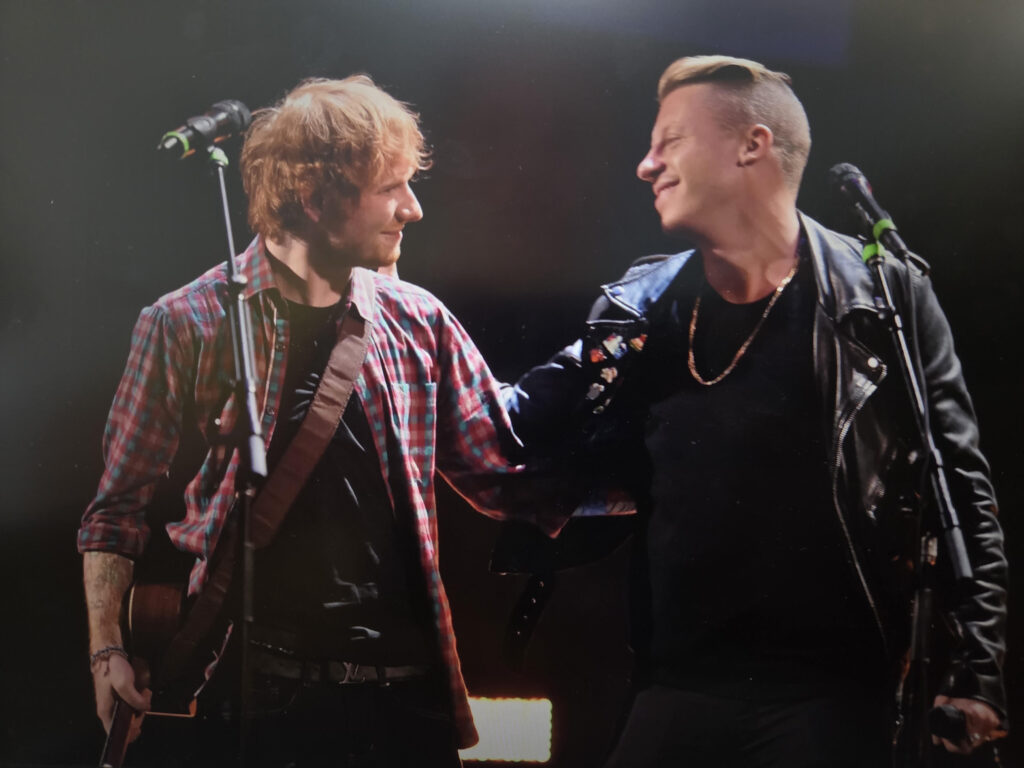
When Macklemore took the stage at MetLife Stadium in New Jersey on Sept. 4 as an opener on Ed Sheeran’s Loop Tour, he said, “Free Palestine. I want those words to be loud and clear, so the people from Gaza, all the way to the occupied West Bank, know that we have not forgotten them.” Within days, he was off the tour’s remaining U.S. dates. The standoff involved the pop superstars, NFL stadium owners and a wave of artists who walked away from one of the year’s biggest tours.
Macklemore said in an Instagram statement that a week of “difficult conversations” with Sheeran ended “in a place of fundamental disagreement.” Sheeran said the decision came from the promoter, Messina Touring Group, after he learned venues would pull shows that included Macklemore, namely Robert Kraft as one of the venue owners involved.
Sheeran, who said he doesn’t use his platform for politics, added that staying publicly quiet “doesn’t mean [he doesn’t] care.” Macklemore was more blunt, saying, “Taking a side can cost you. Money, brand deals, sponsorships, festivals, private shows, relationships and access. I’ve lost all of those things. But there is no neutral position between the oppressor and the oppressed.”
Four other acts left the tour in the following days: Aaron Rowe, Lukas Graham, Finneas and Beoga. Rowe said he couldn’t “allow billionaires to use their position of power” to silence critics of Israel’s actions in Gaza. Graham said, “Nobody’s bank balance should decide who gets to speak.” At Sheeran’s Philadelphia show, five days after Macklemore’s official removal from the tour, there were no opening acts, some seats sat empty and a small protest gathered outside.
Two music majors at Point Loma Nazarene University said the incident fits a long tradition of artists letting their convictions surface.
“There’s a lot of history behind artists who have their own political opinions, and that comes out through their music,” Ella Hallock, a third-year commercial music performance major, said.
Owen Windham, a second-year music education major, pointed to gospel music, which carried religious language along with political references.
“Music is always going to have elements that will be political,” Windham said.
For artists like Macklemore, Windham argued, politics are central to who they are. Bob Dylan, for example, “was always political,” so staying silent on stage “would feel like he’s faking,” Windham said.
Neither student found Macklemore’s remarks especially shocking.
“I feel like it’s kind of predictable, honestly,” Hallock said, adding that Sheeran “should have known what he was getting into.” Windham was less certain it could be predicted, noting that “musicians are passionate and kind of unpredictable people.” He didn’t see the remarks as disrespectful to Sheeran, since Macklemore has his own following. Hosting a stadium show, he said, means accepting that “they might say things that you disagree with.”
Compared to online spaces, the conversation looks different on a campus where faith shapes much of the culture. Windham said no one restricts the music students make here at PLNU, but he hasn’t met many who want to make overtly political music.
“Our politics are fueled by our religious beliefs, but it’s not like all Christian music follows one political guideline,” Windham said.
Hallock described political conversations at PLNU, explaining how these conversations often return to Jesus. Hallock said that Jesus is the answer to everything but admitted that it can feel like an easy answer at times.
Artists have always had to weigh what their voices cost, and asking whether to speak or stay quiet is best, the question hasn’t gotten any easier. As Hallock put it, “There’s certain things politically that are just really … not black and white.”

 Grace Chaves
  Adee Tulcan