

Turning heads on Friday nights and making an impact on Point Loma Nazarene University’s culture for over a decade, Loma After Dark continues to create an open space for PLNU’s students this semester.
The program’s goal is to build exciting nightlife events for students twice a month. What students might see as simply a banner on Caf Lane takes time-consuming work, intentionality and two driven students behind the scenes making it happen.
“My personal hope for Loma After Dark would just be to continue being a space where students feel comfortable to show up, be themselves, meet new people or hangout with friends, and that it wouldn’t feel like an exclusive kind of place,” Katie Macalinao, a second-year media communications major and Loma After Dark’s co-coordinator of marketing and operations, said.
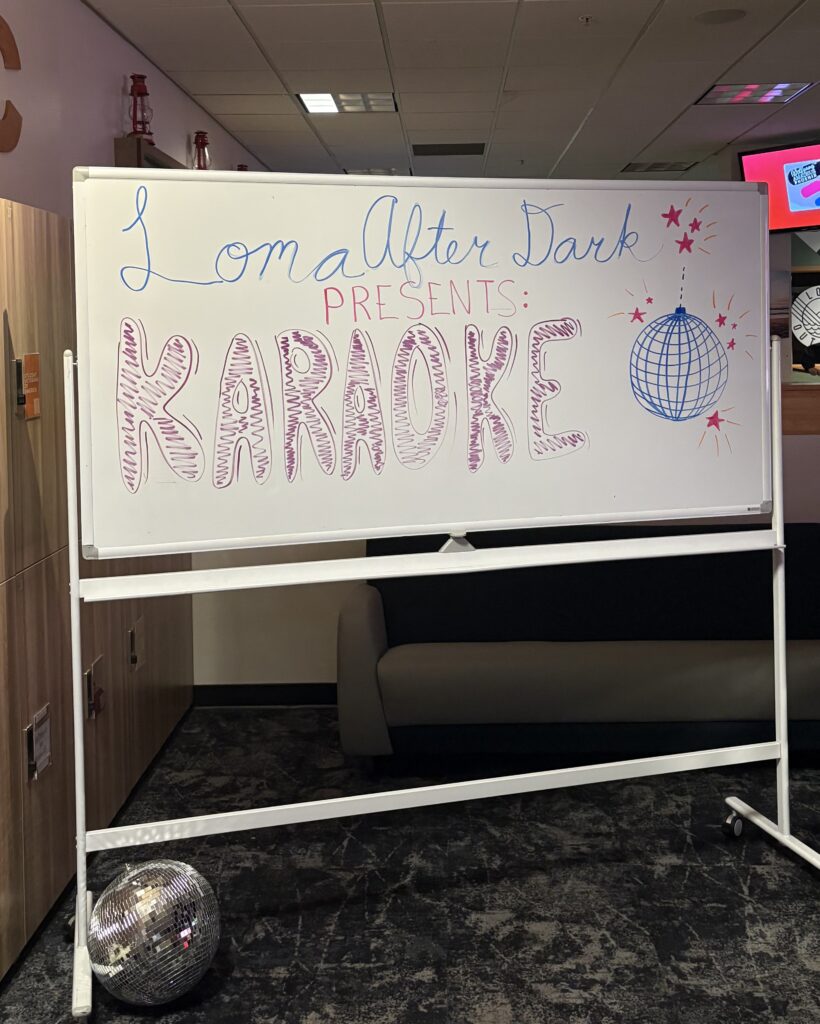
From karaoke events to toga making, the program was proposed over ten years ago by Milton Karahadian, director of Nicholson Commons, to fill the gap between what students might want to do on a Friday night and what was offered on the quiet campus during that time.
“I felt like we needed some late-night programming, not just for freshmen, but for anybody who maybe doesn’t appreciate or doesn’t like to go to the other activities that are provided,” Karahadian said. “This is more focused on medium-sized groups of people that want to get together.”
The best way to reach a broad variety of people is to “build a space for students, led by students,” Macalinao said. Each year, the program is run by two student leaders who adopt the creative mindset and responsibility.
“I believe in student-run everything, and that’s probably a nuance that people don’t know about,” Karahadian said. “They always think that there’s somebody in the background, or there’s somebody that’s leading this, but I let the young people run the … group. They know best what their people like.”
The heart of the program may not be apparent to the average PLNU student, but the work that is poured in has resulted in early turnouts of almost 100 students for each event.
“In comparison to last year, I would just go to the events, show up whenever I wanted to, and leave whenever I wanted to, and I didn’t feel a whole lot of buy-in because I didn’t know fully what it was about,” Macalinao said. “To now taking it over, since I see the work that’s put into it and just the heart behind it, I understand the mission more of why it was created in the first place.”
Macalinao said that being both a student and co-leader comes with its own challenges, regardless of being a pair who equally share the workload.
“I would say [the most challenging part is] the communication side, because when you’re planning an event, depending on how big it is, there’s so many people to talk to,” Moriah Kamph, second-year marketing major and Loma After Dark’s co-coordinator of marketing and operations, said. “That’s people in the art and media services, and the people who do print services, and just all the set-up, accessing the [traditional undergraduate academic] calendar and planning around so many other campus events to book our space.”
The leaders behind the program said they put time and effort into producing events before the school year had even started but each new year still requires trial and error.
“[Macalinao] and I planned the events over the summer, so that was a fun time to dive into that a little bit,” Kamph said. “I think there are events that are popular, like Karaoke we had to bring back, and obviously we had a really good turnout. Having creative freedom is a little bit intimidating because you don’t know what’s going to land with people and what’s going to flop.”
Loma After Dark additionally gives freedom to leaders within the organization to choose their own successors when the time comes. Coming from the minds and hands of those who know what it takes to run this program, there is a rhythm for transition at each turn of leadership.
“We try to do a transition where we hire somebody in February or so, and they stand alongside, and they see how it’s run,” Karahadian said. “They see how to organize it. We have meetings together, and they work with them on the projects, [learn] how to use a credit card, how to schedule and all that kind of stuff. So they learn on the job, like an internship.”
Despite the mechanics of the program, the transition of leadership and technicalities of what makes its gears turn, the heart and purpose of Loma After Dark is the driving force. This program is not built to compete with other campus-wide events, but to be a smaller, safe place for those who may need it year after year.
“I just hope that a student who maybe doesn’t have plans on a Friday night and is lonely can show up and find community within this space,” Macalinao said.

 Grace Chaves
  Kailyn Collette