

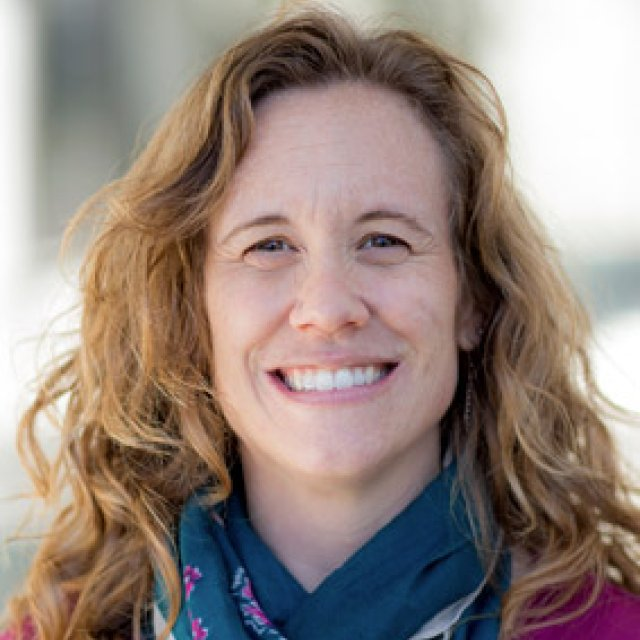
Ariane Jansma, Point Loma Nazarene University professor of chemistry and a woman who has spent more than a decade researching the link between the sexually transmitted infection HPV and cervical cancer, is a coffee drinker — milk, no sugar — but she keeps a tea kettle in her office just for students.
This defines her as a professor: accommodating but not overly sugary.
“She’s an icon,” Isa Ortuno, a fourth-year dietetics major, said.
After the recent COVID-19 pandemic, the number of Ds and Fs in science courses at PLNU, especially in the CHE 1052: General Chemistry I course, Jansma said, increased dramatically. Some high schools prepared their students well during the pandemic, but others left students without the quantitative reasoning or math skills necessary for such a reasoning-reliant path.
But Jansma dislikes the idea of a weeder class, a common nickname among students for classes such as General Chemistry, that she and her colleagues are well aware of.
“We don’t like ‘weeder,’” she laughed. Instead, she called it a benchmark class because there are skills taught there that are crucial for many scientific careers, even if the material won’t be relevant to everyone.
“Students say that all the time: ‘I do not need to understand redox (a type of chemical reaction) to be a physical therapist,’” Jansma said. “And it’s like, ‘No, but you need to understand how to take this numerical data, make sense of it, and do something with it.’”
But with the recent grade drops that resulted from the pandemic, this has become more complicated.
In response to the issue, Jansma developed a rescue course for students who are struggling with General Chemistry. Its purpose is to provide a place to build skills to help them pass in the future. This would allow them to drop out and receive a “W” for withdrawal, instead of a D or an F on their transcript.
The number of failures has decreased as the pandemic shrinks further into the past, but this doesn’t mean the problem has been solved.
“I think that just shows us that some of the numbers that are still there might be more long-term,” Jansma said. “Maybe this is a deeper problem inherent in school systems. … I can’t change what … our students are getting before they come here.”
Jansma didn’t see herself becoming a scientist
Jansma didn’t know she was interested in chemistry until high school. Her teacher was a “huge football player guy” who would stand up in front of the class and say, “Chemistry’s fun!”
“You’re like, ‘Oh my gosh. Oh, OK, if you say so — because you’re terrifying,’” Jansma said. “But the funny thing was, after a year of that, I was like, ‘Oh my gosh, this is really fun. Like, I love this.’”
But it wasn’t all beakers and fellowships from there. Jansma said that when she was in third grade, her teacher told her mom, in front of her, “She’s going to do great as long as she just avoids math her whole life.”
“What a horrible thing to say right in front of a kid,” Jansma said.
To some extent, though, the teacher was right. Math continued to be a struggle for her through school, but she loved chemistry. And chemistry involves a lot of math.
“So I got all the way through AP Calculus, started saying, ‘OK, I’m going to learn this if it kills me,’” she said.
She did this in pursuit of becoming a doctor, but when the time came to apply, she sent out 50 medical school applications.
Fifty rejections came back.
This, eventually, led her to her post-doctoral research on HPV and its link to cervical cancer.
Jansma found her niche in a cancer-causing protein
Newly pregnant and recently graduated with a doctorate in biochemistry, as the 2008 financial crisis ravaged the biotechnology industry, Jansma eked out a job that didn’t previously exist: She did research for a chemist at Scripps whom she admired by offering to fund her own salary. She applied for a fellowship and received three years of funding from the National Institute of Health, and discovered the project she’s been researching ever since.
Jansma laid out a list of disclaimers about the importance of her research, saying that “there’s probably about 10 other reasons in there that are subtle and hard to differentiate and hard to discover,” and that it’s “a really complex puzzle.”
However, the differences between cancer-causing and non-cancer-causing HPV hadn’t previously been found. “All the hot spots (where the damage is done) are the same between high-risk and low-risk,” Jansma said. Turns out, they may have been looking in the wrong place.
“What we found were residues that no one had considered important,” she said. “They didn’t apparently do anything, but they’re necessary for good phosphorylation.”
Phosphorylation is the process that leads to cancer suppressors getting turned off. Cells have a lot of checks and balances and self-destruct buttons that protect against uncontrolled cell growth, but these amino acids are a weak point.
Audrey Vazzana, a PLNU biology and chemistry alumna, worked for Jansma during the summer of 2024, researching the mechanism of phosphorylation at that weak point. When poring over the existing literature to find what niche their research should fill, she and her research partner, Abby Mandagie, kept coming back to one thing:
No one knew how the phosphorylation was happening.
In order to start breaking open the mystery, Vazzana and Mandagie created a joint honors project.
Every day, they caused HPV DNA to mutate, introduced it to bacteria, caused it to express a specific protein, then harvested the protein — a process that took 8 to 12 hours and required a variety of specialized equipment.
Jansma aims to make an impact through education
As a result of their work, both Vazzana and her partner are listed as co-authors on Jansma’s recent article, published by the Multidisciplinary Digital Publishing Institute in June of 2025.
Jansma said she doesn’t think idealism and wanting to make an impact on the world through one’s work are limited to younger people.
“I’m old and idealistic,” she said, laughing. “I think that all research changes things. I think that all knowledge changes things.”
But her impact is not limited to her research.
“I also think that I’ve sent students into medical school and graduate school and all these places with a better knowledge of HPV,” she said. “And possibly a better knowledge of how viruses work and all of those things, and I think that in and of itself is magic.”
