
Dolphin whistles and whale calls echoed from the speakers in Latter 101 on April 8, signifying the start of the first monthly meeting of the American Cetacean Society.
More than 50 people had gathered to learn more about cetaceans, a type of marine mammal, and their understudied types of communications. The room was full of Point Loma Nazarene University students interested in biology and seasoned researchers settled into the field, united in a common goal to understand the current literature on the subject.
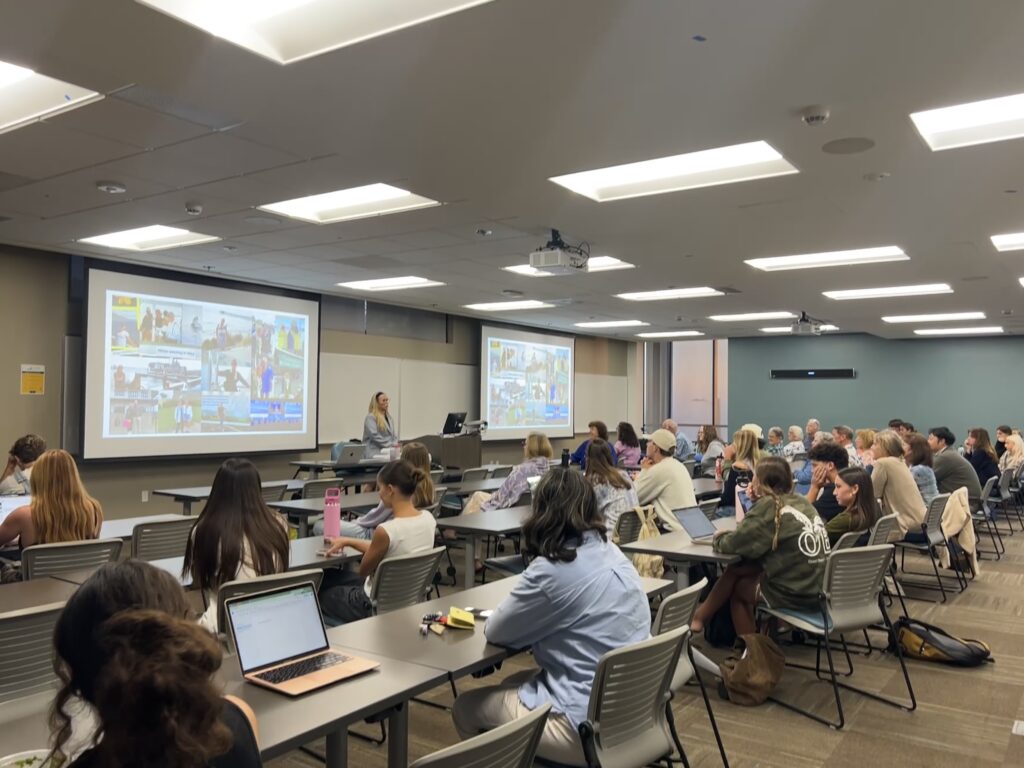
Covered in the presentation titled “Dialects and Gossip Among Cetaceans,” and acoustical behavior expert Ann Bowles divulged their research on how cetacean communication is studied and its importance in environmental structures.
Marine biologist and PLNU biology professor Walter Cho warmly welcomed the two speakers, allowing Bowles to take the stage first. Under the impression that most of the audience had a remote understanding of marine animal behavior, Bowles briefly covered the types of sounds in toothed whale communication: whistles, pulsed sounds and biphonations (a mixed call).
Bowles emphasized the difference between echolocation and species-specific calls, where the difference is vital in understanding the motives behind an animal’s behavior.
To demonstrate this notion, Bowles called two volunteers from the crowd to play a modified game of Marco Polo. As the lights dimmed, the two individuals were prompted to call out each other’s names and united after a few exchanges to showcase echolocation. In contrast, the other form of communication had the participants stating their own names to announce their presence and united after a few calls.
Bowles described how research centered around “dialects” among the animals differed between groups, specifically for that of killer whales. A pod found in one region had a completely unique set of biphonic vocal bursts from another, like that of various human dialects of the same language.
A question from the audience regarding playback experiments — where dolphin noises are recorded and then replayed through underwater speakers — with marine mammals arose.
“That’s the struggle as a mammalogist. Most playback experiments are one trial experiments because the mammals figure it out the first time around,” Bowles said.
After Bowles concluded, Gierhart was invited to speak about her 2024 study on dusky dolphin behavior and communication in conjunction with documented vessel movements. Found in the deep-water canyon of Kaikoura, New Zealand, dusky dolphins are an unresearched dolphin species that Gierhart felt called to learn more about.
Gierhart’s study has paved the way for an acoustic research project exploring how vocalizations vary across social and human-influenced contexts, with a particular focus on sustainable tourism.
The meeting concluded with a Q&A session led by Bowles and Gierhart, where the floor was dominated by ACS members with the occasional question from a PLNU student.
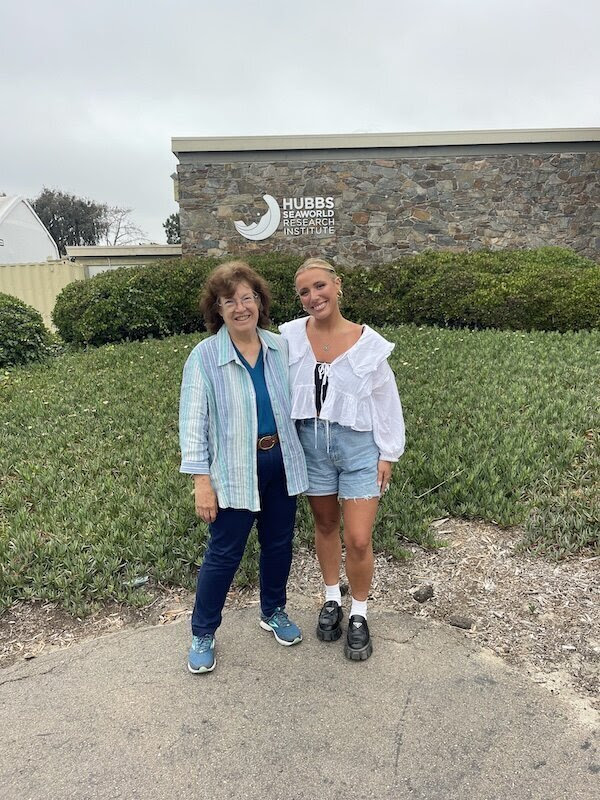
In an interview following the presentations, Gierhart explained how ACS ultimately chose PLNU as their new home for monthly meetings.
“I took all the marine biology classes, and all the animal behavior classes, but there was this part with marine mammals that I was missing,” Gierhart said. “ACS has a San Diego chapter, and it’s so easy to get students involved, and I wanted to bridge that gap.”
As a PLNU alum, Gierhart emphasized that science students, specifically those interested in marine biology, often struggle after graduation to find career opportunities.
“No one is holding your hand when you graduate and if you really want to do something in this field, you’re the only one that’s going to make it happen,” Gierhart said.
Many students felt that this meeting was a glimpse into a hopeful future and encouraged many interested in ecology and marine biology to connect with ACS members.
Alexander Kuhn, a third-year environmental science major, was inspired after attending the event.
“I thought it was a really awesome opportunity to get to learn from experienced researchers. I think it’s cool to be surrounded by students and members of the community that share common interest,” Kuhn said.
Further updates regarding the ACS San Diego Chapter can be found on their Instagram page.

 Emily Jones
  Grace Chaves