

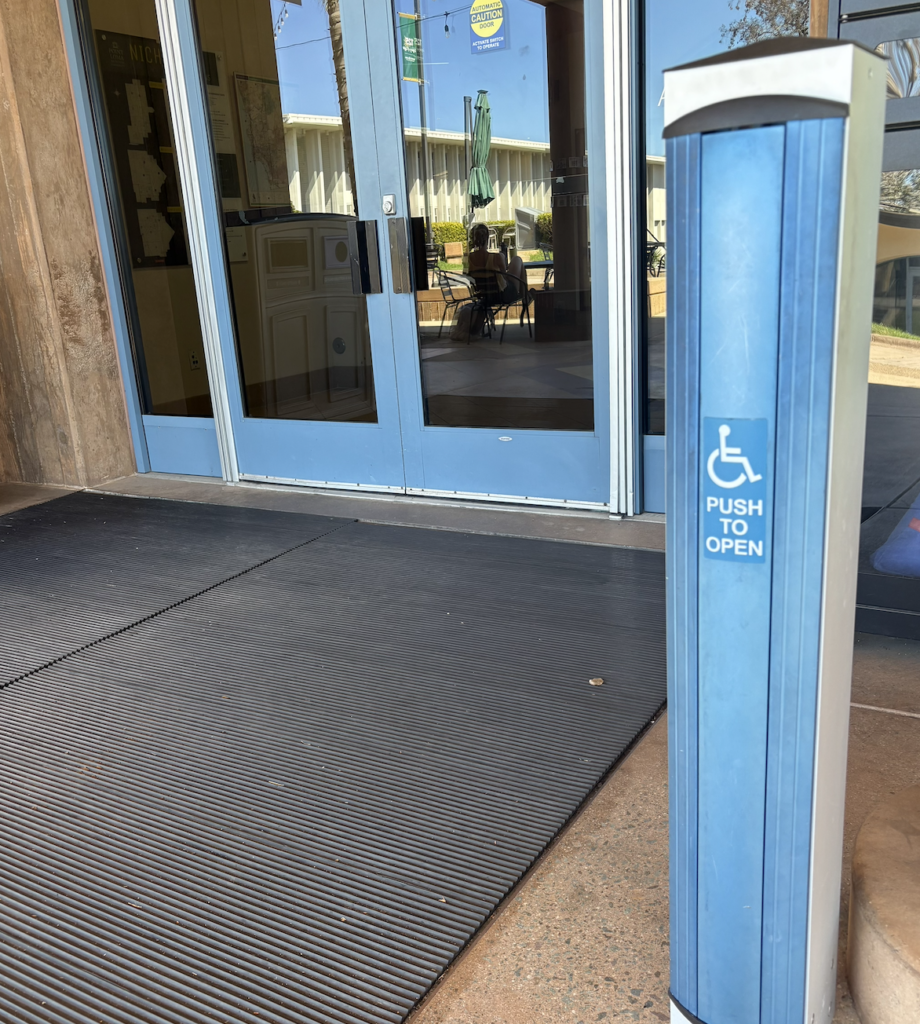
Not everybody thinks about accessibility everyday, but for someone trying to navigate a college campus with a disability, it can be unavoidable.
I spoke with several individuals affiliated with the Educational Access Center (EAC) in order to find out how PLNU’s campus can be more accessible for everyone. As a student who understands the struggles of accessibility all too well, I hope the EAC can provide a beneficial solution for students, especially those with disabilities such as myself.
“PLNU adheres to federal and state laws regarding equitable educational access for students with disabilities,” Pamela Harris, associate dean of the EAC, said. “Accommodations are determined on an individual basis.”
As I spoke with Harris, I learned that the EAC is continuously working to ease navigation of PLNU’s campus for students with disabilities. One such project is a map that would include “locations of elevators and bathrooms [that] would be very helpful for students with disabilities.”
“It’s [the EAC’s] mission statement is to make Point Loma more accessible and open-minded towards diverse cultures and walks of life,” Blake Bridges, a third-year environmental studies major and student worker for the EAC, said. Bridges proposed several solutions to me to assist students with any necessary disability concerns to be addressed.
Bridges expanded on the aforementioned plan for the EAC to create an interactive map. The map, as Bridges explained, needs data that explains “where the buildings are located.” As for the format of the map, Bridges implied that a paper map was the starting point, but he also proposed that an online version of the map should be available as well.
This app, which is not currently in development, would serve the purpose of notifying students of a specific accessibility concern. Considering how the on-campus elevators occasionally break down, this potential app would send a message to the students alerting them when this happens. This would allow students to prepare for taking an alternate route the night before, such as relying on a friend with a car to drive them to class.
“Regarding an updated paper map, it is our responsibility to make campus maps as clear and helpful for students dependent on navigating the space,” Hannah Gibson, Nease West residential director, said. “This includes key markers that the average abled persons would not consider; single stall restroom locations, elevator makers and clear indicators when a floor on campus will not be accessible for specific needs.”
As a residential director, Gibson said she “listen[s] and learn[s] what gaps need to be filled” in terms of figuring out how to accommodate students’ needs.
In addition to the EAC, there are additional ways for students to accommodate accessibility concerns.
“Students are always welcome to contact their RA or public safety in times of emergency or immediate need,” Gibson said. “The campus EAC would be the first point of contact. Sabrina [Mathisen, senior manager of student life] and her team are able to work with individual student cases to prevent issues from occurring ahead of time.”
The EAC aims to help students through thinking about what is limiting a specific student to engage in their community and environment based on physical or mental abilities. Hearing about how the EAC operates through different perspectives can certainly help and inspire students of any kind on this campus. For students who do not have accessibility issues, projects like the EAC map can allow regular students to aid disabled students. With this map, the EAC hopes to make PLNU a very welcoming and inclusive campus to any and all students, regardless of background, academic year or disability concern.

 Madelyn Lucas