

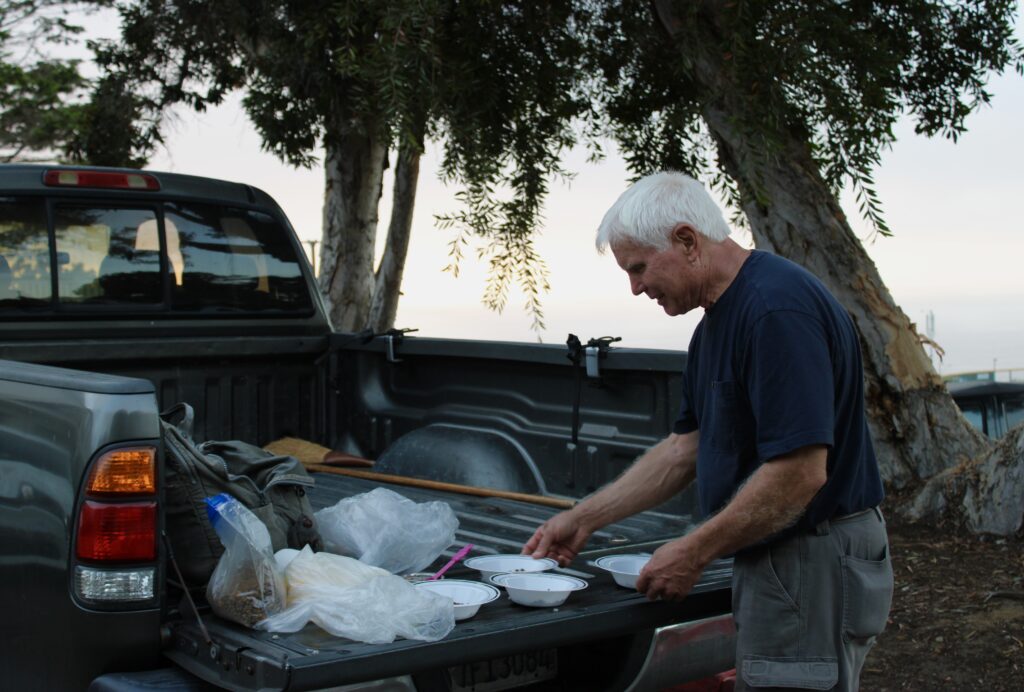
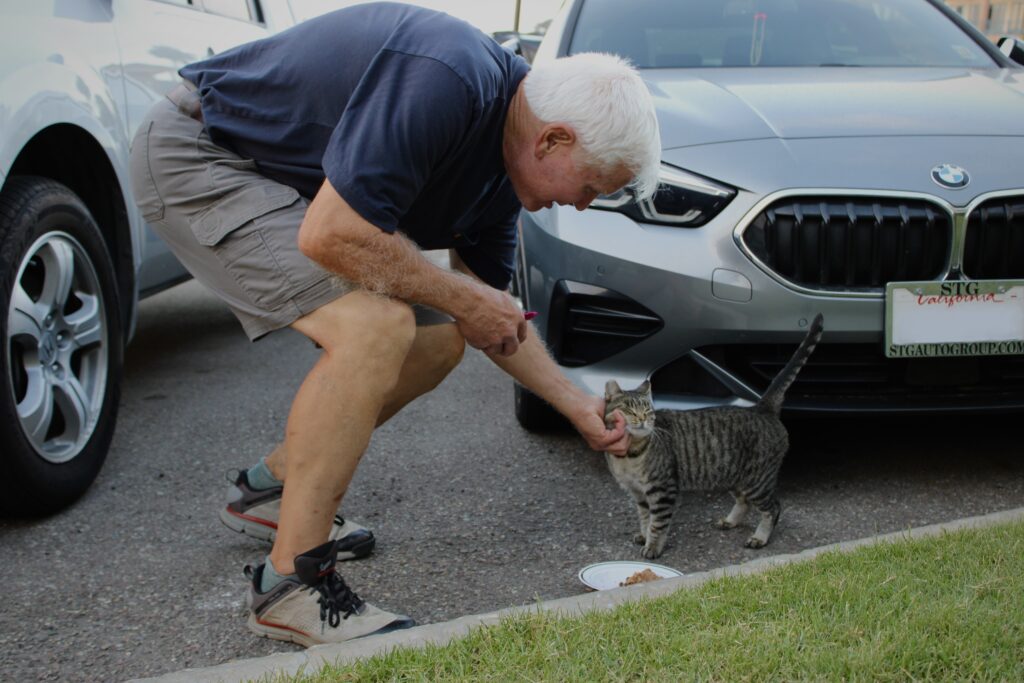
Everyday as students pass the Fermanian School of Business or as they head to their dorms through the Nease Garden pathway, students will see a man filling up bowls of cat kibble as the stray cats come out of their hiding spots to greet him and get their daily meal.Jim Gaupsas, 74, has been feeding the cats on Point Loma Nazarene University’s campus for nine years now. Gaupsas was never a PLNU student himself, but living close to campus, he and his wife began to take walks on campus where they first noticed the cats.“We started with just two cats that were up by the picnic table, and it was before Christmas that one of the workers said, ‘There’s cats down at facilities and nobody’s here to feed them,’” Gaupsas said. “So we went down to the facilities and there were 15 cats down there. So we started feeding them [as well].”Over the years, the number of cats has decreased, mainly in the Campus Facilities area where the 15 cats are now five. Four of these cats previously on campus were taken in by Jim due to injuries or other health concerns. One had a broken leg, one had an eye infection, another had a ruptured cruciate ligament in her back knee and the last was a runt of a litter that they believed was going to pass away if kept outdoors.When Gaupsas and his wife first started feeding the cats, administration had advised them to not feed them. Administration believed the cats caused problems — which Gaupsas said were “really the raccoons causing the problems.” The first two cats Gaupsas began to feed warmed up to him quickly. However, with administration being skeptical about the cats at the time, one of the secretaries took the two cats and relocated them to Julian Farm and Orchard. The cats did not adapt well, leading Gaupsas to drive up to Julian and attempt to bring them back to campus. He was successful in bringing one cat back after it had been gone for four months, but the other had disappeared.“He knew when he was home,” Gaupsas said.Gaupsas did not remember the name of the secretary, and when trying to reach out to Julian Farm and Orchard their staff was unsure of any history behind the cats or the secretary who had relocated them to the farm.They finally got approval from administration after his wife had written a letter to Jeff Bolster, PLNU’s vice president for university services.“When I came into this role about eight years ago, [Gaupsas] had a previously established relationship with PLNU,” Bolster said via email. “We looked into best-practices and found that USD and SDSU have similar agreements that can compassionately and humanely control the cat population on our campus. [Gaupsas] and his wife abide by a strict set of guidelines for access to the campus, as well as their limited activity while here. They have demonstrated a commitment to abiding by [the guidelines], and serving this important need on our campus.”After receiving the permission to continue feeding the cats, they spayed, neutered and got rabies shots for all of them. They have been feeding them every day, “rain or shine,” as Gaupsas said. If they can’t make it to campus for the day, they find somebody to step in for them to make sure the cats have not missed a meal.Gaupsas stated that some students have come by to either say hello or to help feed the cats. He believes that if students spend some time with them they will warm up, sometimes even perching in their laps.With the daily feeding, on top of medical bills for these cats, Gaupsas said that his wife had figured the total cost to be about six figures in the past nine years.“[I’m about to go] into retirement, you know, we’re looking for alternatives to kind of pare down the expenses,” Gaupsas said. “So it would be nice if something came around, but we wouldn’t just abandon them. We can’t do that.”Gaupsas had suggested an idea for a program to build a cattery, where students could get to know these campus cats and have them volunteer to buy food.“If they made a cattery where they could enclose them and have students get to know them, that’d be kind of neat, I think,” Gaupsas said. “They’re all so approachable, really, once you spend a little time with them. All it takes is a little bit of time.”Gaupsas spends around 10 to 15 minutes putting out food and picking it up, making sure other animals do not come to the area to take the food. Despite the help students could offer, Gaupsas mentioned that he believes administration would frown on it due to liability issues. He mentioned that although he does not believe the cats would harm any students, it would be bad for not only the students but also the cats if an incident were to occur.When asked about his favorite part about doing all of this, he mentioned how the cats will walk up to him with a “loving look” in their eyes, “that look of trust” he said.One student, Kaelyn Glendrange, a third-year biology student who had walked the Nease pathway to her dorm, said that she saw the cats run out to Gaupsas the moment they noticed him.“I have loved getting to see the cats and [Gaupsas],” Glendrange said. “The cats love him so much. I always see them run out when he starts walking over.”Gaupsas said that these campus cats have grown close to his heart.“They’ll see or hear the car coming around the corner and they’ll come out to the parking lot to greet us,” Gaupsas said. “We’ve grown to love them, and they’re kind of like our cats away from home.”

 superadmin
  Camden Painton