

Curling up under a blanket with a hot mug of something comforting is a famously good way to enjoy a book. Poetry, however, is often shared publicly in front of crowds, as it has been since before stories were written down. Some simply enjoy sharing their art, others come because they see poetry as activism, and still others embrace the community poetry creates.
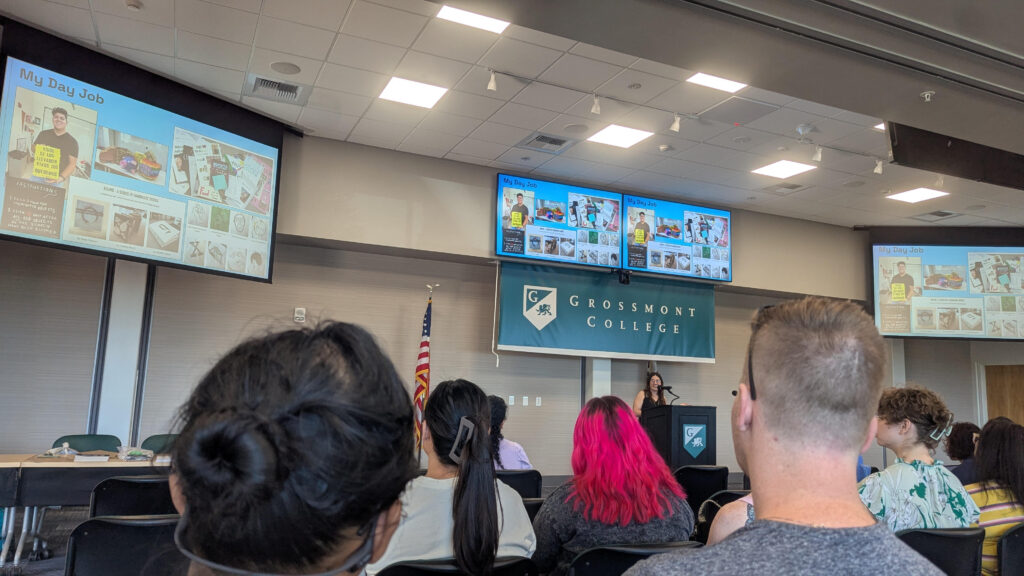
Paola Capó-García, 2025-27 poet laureate of San Diego, led an open-mic-centered poetry event at Grossmont College on March 18, which allowed students to add their voices to the ancient art form and eat pizza in the air-conditioned shelter from the 88-degree soup bowl tucked behind Cowles mountain.
The optional-but-encouraged theme of the open mic was “Leading the Change: Women Shaping a Sustainable Future,” which neither the open mic-ers nor the poet laureate followed.
The scheduled opener, a student named Taj Morgan, began with a moving poem about her legs. She spoke about the shame she used to feel about the shape of her body and the gratitude she now feels for it, the pride she has in her legs, and the joy at being loved in the body she has.
Then, the quiet crowd of undergrads with under-dye mullets and names like Cricket and Snip watched in fidgety silence as two students read their open mic pieces: a nervously-delivered poem and a short fantasy story about a black and white castle.
Capó-García was not daunted by the shyness. As poet laureate, her job is to bring poetry to communities all over San Diego, which means she sometimes meets people who tell her they’ve never read a poem before. She took the stage.
“The life of a writer is a life of rejection,” Capó-García told the young writers. “And you have to realize that that’s part of the game, right? … Your writing might not be for everyone, but then that one person reads it and it makes sense to them.”
Capó-García flipped through her poetry book, “Clap For Me: That’s Not Me,” to a poem that she said “presented itself” to her. It was called “Boy-ness,” which she said was ironic to read during Women’s History Month, so she followed it with a poem about “Girl-ness.” She read another about the person she wishes she were, how she hopes to be remembered and another about her grandmother. She also read a poem about how her name is often mispronounced, called “Self Portrait as a Difficult Name.”
“Paola is every other girl’s name on my side of the world, but far too exotic for this side,” Capó-García said. “When I explain my name, I always say, ‘It’s like Pa-hola.’” She added a little wave to go with “hola.”
After she described her role as poet laureate and a little about her day job as a teacher at High Tech High School, she invited the room to participate in a writing exercise.
The exercise is based on a line from one of Capó-García’s favorite poets, Lisa Robertson, which Capó-García used as the epigraph of her poetry book.
“What am I today?” Capó-García invited the audience to ponder. “I’m going to ask you to write something right now, whether that’s a poem, a short story, a list, whatever form that takes shape in.”
The audience that had shied away from the microphone had merely lacked confidence, not interest. For 10 minutes, you could hear a pin drop as they vigorously answered the question on clipboards and notebook pages.
“Today, I am sleep,” I wrote. “Prowling, hunting down a body that will not have me. Today, I am the cracked earth of lips missing the creek left behind.” I had gone to bed late, and it was very hot outside.
After the exercise, many fears were conquered, and many first drafts of poems spilled over the barely cooled gathering place as students stepped up to the microphone.
Writers answered the prompt by giving themselves lists of epithets. Some focused on the “today” part of the prompt while others honed in on the “I” part. There was a uniquely worded poem about wearing pink to a funeral, a silly poem about food and a few others.
Emcee Pegah Motaleb, an English professor at San Diego Mesa College who helped organize the event, announced the next speaker.
“Javier?” she called.
After a few tries, a disgruntled voice popped up from the back of the room. “Did you mean Ex-zavier?” he enunciated. Motaleb apologized, but Xavier sighed at her a few more times before finding his rhythm. Maybe every other boy on some side of the world is called Xavier.
Grossmont is a community college, meaning its students don’t live on campus. The open mic was at 2 p.m. on a weekday, and, except for one student, Motaleb is not their professor. Despite all this, about 20 students took the time out of their day. It’s possible that some were there for extra credit.
Jaden Crenshaw, a Grossmont student who read an inventive poem using Halloween and her growing distaste for sweets as a metaphor for a different kind of hunger, attended the open mic for the feeling she gets out of them.
“I like the adrenaline before going up,” she said.
To her, a public display of art creates the same unity that people seek in religion.
“I think that the reason why humans have religion is because we need to feel like we’re a part of something,” Crenshaw said. “Art and poetry makes us feel like it’s a part of something.”
In any given month, there are over a dozen open mic or other poetry-related gatherings in San Diego. Many of these are organized by Capó-García, and though many San Diego poetry events cost money, almost all of hers are free to attend.
Capó-García was a journalist before becoming a teacher and a poet.
“Journalism is about facts,” she said. “For me, poetry is about truth. … I love that you can invite fiction and experimentation in poetry that you can’t necessarily do in journalism.”
Her favorite part of events like this is meeting new people, and she loves including writing prompts.
“I love any event that’s generative, where people can actually walk away with something they made, versus just sitting and listening to me talk,” she said. “That’s not as interesting to me, like I’d rather they get something out of it.”
Capó-García, like Crenshaw, is not religious, but there is something of the spirit she finds in the art.
“In some ways, I think writing is of the soul, about the soul, and it’s a sort of searching,” Capó-García said. “I think it can feel very spiritual when you’re trying to connect with something greater than you. I say this as someone who identifies as an atheist.”
She is still determining what the word “spiritual” means to her.
“For me, the spiritual and the political are really tied together, and so I always think of my poetry as really political, but now I’m finding it interesting to think, ‘Is there a spirituality to that?’” Capó-García said.
Motaleb also sees poetry as political — a tool for activism she wants to give her students, in the same way that the poets she reads gave it to her. “I tell my students in the classroom, ‘you’re not just performing to emotionally move your audience, you’re teaching them.’”
In class, Motaleb and her students read the work of several Palestinian poets who wrote about “the genocide that we are watching right now” before being killed by Israeli airstrikes.
One such poet, Nour al-Din Hajjaj, wrote to bear witness to the joy he lived through and to protest its erasure. “I do not consent to my death being passing news,” he said. “Say, too, that I love life, happiness, freedom, children’s laughter, the sea, coffee, writing, Fairouz, everything that is joyful — though these things will all disappear in the space of a moment.”
He was killed 10 days later.
Most of the poems read at Grossmont’s open mic afternoon were not groundbreaking and will receive little fanfare. Still, it mattered that they were written, and that they were spoken and experienced in community.

 Grace Chaves
  Adee Tulcan