

Editor’s note: The direction the children head when boarding the trains was updated to reflect a more accurate direction.
A recent event at Point Loma Nazarene University took attendees on a journey of the Tijuana-U.S. border being built, the people who crossed it for survival and children riding the train from Chiapas to the Guatemalan border.
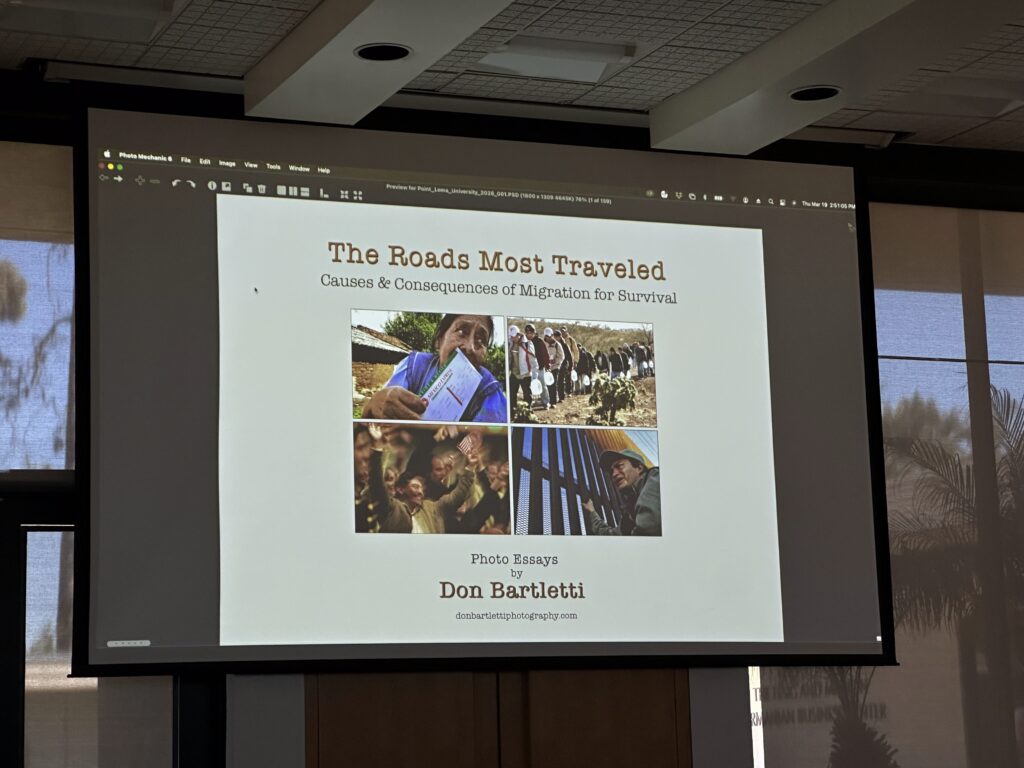
“The Roads Most Traveled: Causes and Consequences of Migration for Survival,” a presentation by Pulitzer Prize winner Don Bartletti, took place in the Fermanian Conference Center on March 19.
Bartletti, a retired photographic journalist, shared his photographic journey through Mexico.
Attendees saw images of the original “schoolyard fence” that once made crossing the border to the U.S. easy, and the progression of the border to its current steel plates that challenge immigrants’ attempts to find another way across.
Bartletti said he is one of the few people who can not only tell the history of immigration in San Diego, but also show it.
Bartletti shared stories of people he had come across throughout his journey, traveling with the adults and children on the train commonly referred to as La Bestia (The Beast), and what made them choose to journey to the U.S. One 12-year-old boy stood out to Bartletti the most.
“Denis Contreras,” Bartletti said during the event. “He taught me how to get on and off the train. Well, I’m still friends with him.”
Contreras had immigrated to California from Honduras to find his mother and stood out to Bartletti as the most well-dressed person he had come across, as he wore different clothes each time he saw Contreras again.
Hayden Gielda, a fourth-year biology major, attended the event out of interest and hoped to learn from different perspectives on immigration. Contreras’ story stood out to her.
“[Bartletti] was able to follow up with him from childhood into adulthood,” Gielda said in an email interview. “It showed that even after successfully crossing the border, the challenges and fears that immigrants have never go away.”
Dale Gardner, a fourth-year biology major, said the photo of a sign that warned truck drivers of the immigrant who would run across the Interstate 5 freeway after crossing the border stood out to him.
“I thought that one captured how dehumanizing the whole situation really is,” Gardner said.
He said he attended the event because he felt that he could benefit from the information and stories told through the photographs.
Gardner thought the goal of the event was to humanize the Mexico-U.S. border and the people attempting to cross.
Gielda agreed, adding how it showed how hard immigrants continue to work to provide for their families.
“It just allows people to have a lot more compassion for what’s going on and not just focus on [immigration] laws,” Gielda said.
Bartletti said he hoped that students would pay attention and learn about the full history of immigration in San Diego.
“I want people to … see their faces, and hear their names and see the images of people who we report about in numbers in political platforms,” Bartletti told The Point. “I want people to see that process of how [immigrants] came here.”

 Grace Chaves
  Kailyn Collette
  Milla Kuiper