
My spring break was spent cooped up at home, scribbling interview questions in a notebook I purchased at Point Loma Nazarene University’s gift shop. Sitting in my parents’ house, I felt both humbled and delighted to be part of the virtual interview room for the 98th annual Oscars.
I felt foolish writing down questions for the directors of “Sinners” and “One Battle After Another,” because I’m a 20-year-old student journalist, not a news anchor or influencer. But after submitting a request to be a part of the Zoom interview room, the Academy Awards said “yes.”
According to the host of the Oscars, Conan O’Brien, over one billion people tuned in for the awards ceremony virtually, where 31 countries were represented. This was reflected in the interview room, with questions and answers going back and forth in various languages. It felt like an undeniable moment of unity, even from my limited virtual perspective.
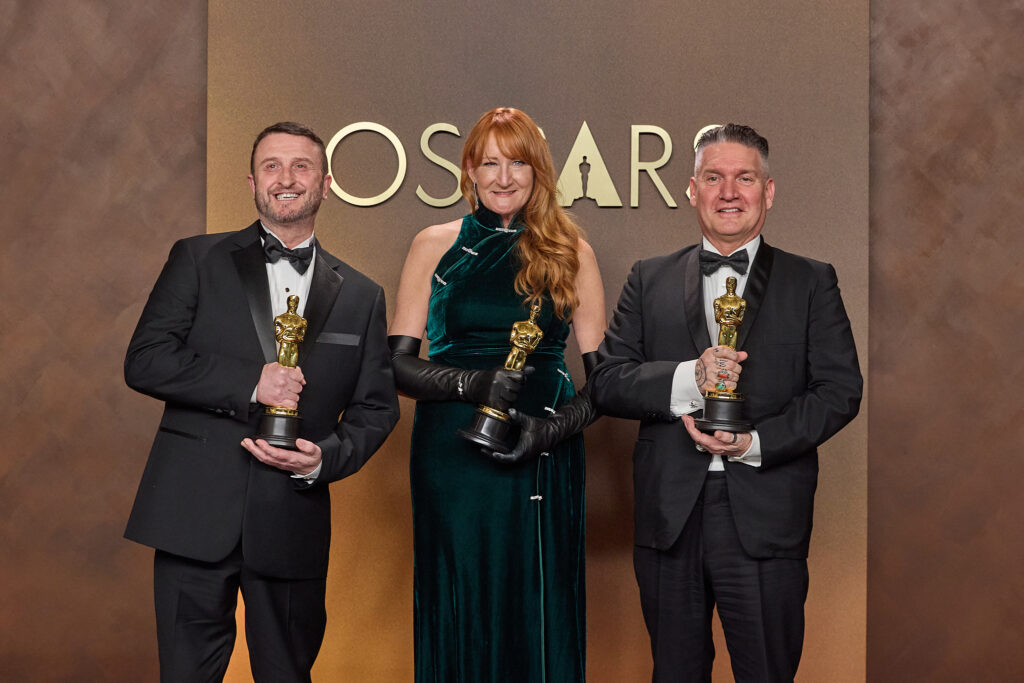
I was able to speak with Mike Hill, a makeup artist and sculptor, who won in the “Makeup and Hairstyle” category for “Frankenstein,” about how they came up with a creative makeup design for The Creature (portrayed by Jacob Elordi) when so many adaptations of the book have been done before.
“For the creature, you basically just had to start afresh and, you know, don’t look at any past interpretations [and] don’t care if there’s an overlap,” Hill said to The Point. “This creature’s been around for hundreds of years now. So it was basically, make him look like he stepped out of the 1800s. Victor Frankenstein was not making an old Volkswagen; he was making a Porsche. So your monster can be, doesn’t have to be ugly, it just has to be different, and that’s what we tried to do.”
Hill explained that they designed The Creature with geometric shapes to make it look like Frankenstein had made it precisely and intentionally. It was this kind of creativity that echoed in every interview and acceptance speech.
“Everyone has a story to tell, and we want to tell those stories,” Cassandra Kulukundis, winner of the Casting award for “One Battle After Another,” said during her acceptance speech.
Telling the untold stories of actors and movie crew members is what makes the Oscars so special. Even during a time when nations are divided, there was something electric about the virtual interview room as reporters from around the world came together with the goal of telling stories.
On the left side of my screen, I watched the ceremony when there was a lull in the interview room. From O’Brien’s on-the-nose political jokes to everyone poking some (probably well-deserved) fun at Timothée Chalamet, it felt like a typical awards show. But there were also some fun surprises, like when Chris Evans and Robert Downey Jr. presented an award together and when everyone in the Dolby Theatre held up a K-Pop glow stick for the performance of “Golden.” Even Steven Spielberg and Leonardo DiCaprio proudly held them up.
The result of the awards themselves was less of a shock — “One Battle After Another” won six out of the 13 awards it was nominated for, and “Sinners” received four wins. “Frankenstein” won three awards, and to the surprise of no one, Chalamet was snubbed in all nine categories that his film “Marty Supreme” was nominated for, following his comments on ballet and opera.
One of my favorite surprises of the evening was Autumn Durald Arkapaw becoming the first woman cinematographer to win an Oscar. As she received the award for her cinematography in “Sinners,” she asked all the women in the room to stand up, “because I feel like I don’t get here without you guys,” Arkapaw said.
People complain about how awful Hollywood has become. Many have given me skeptical looks when I tell them I want to go into entertainment journalism after college. Perhaps they’re right, and maybe I’m just living in a delusion, but the Oscars felt like a moment of unity. It was a moment away from the noise of the news — from talks of war and the uncertainty of what comes next. It was a step back to celebrate and feel that rush of creativity flow through your veins.
“Movies are made for you,” Gwendolyn Yates Whittle, winner of the Sound category for “F1,” said during her acceptance speech. “Go see the blockbusters. Go see the independents. Be inspired.”

 Adee Tulcan