

I rushed to listen to the wisdom of famous authors Judy Woodruff, Jamaica Kincaid and George Saunders at this year’s Writer’s Symposium by the Sea.
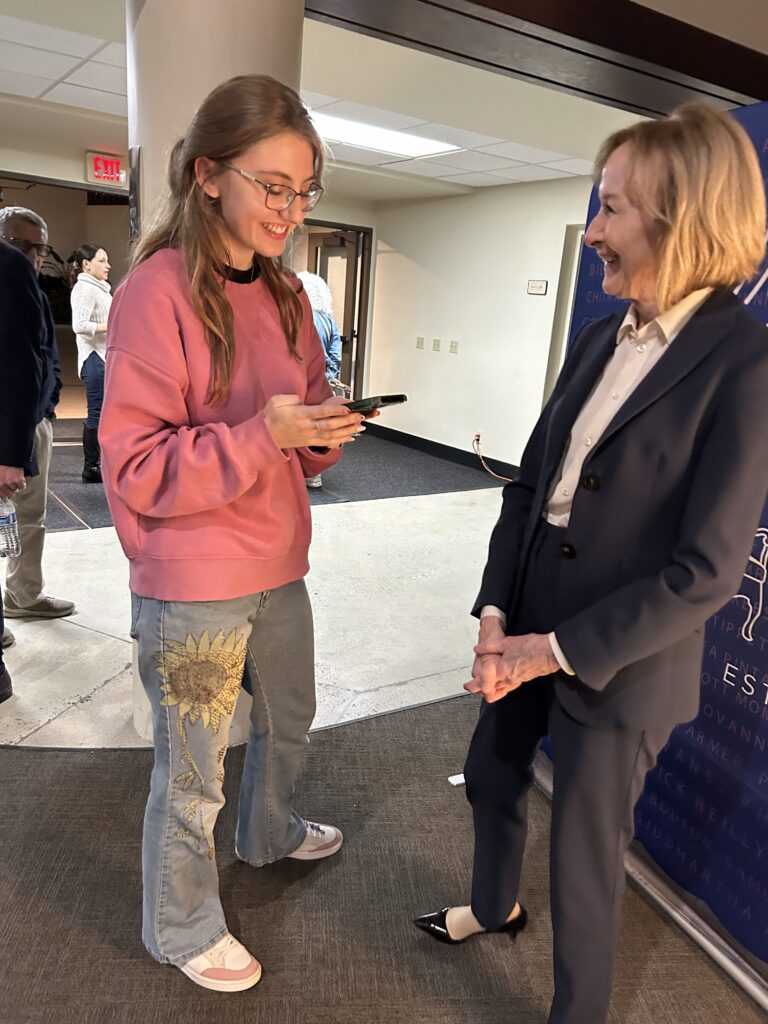
Judy Woodruff
On Feb. 25, 800 PLNU faculty, alumni, students and San Diego community members filed into Brown Chapel to catch the conversation with Judy Woodruff — an instance where the interviewer became the interviewee. After five decades of reporting, covering every U.S. presidential election since 1976, many Emmy Awards and publishing her autobiography “This is Judy Woodruff at the White House,” Woodruff delivered a beautiful balance of realism and optimism to the crowd.
In the discussion led by Dean Nelson, PLNU professor of multimedia journalism and the director of the Writer’s Symposium, Woodruff addressed America’s current state of political division. She expressed her informed belief that social media is partly responsible for the normalization of political aggression.
“It starts in Washington … they’re at each other’s throats, and it’s now infected the entire country,” Woodruff said during the interview.
Woodruff talked about social media’s ability to drive people apart by framing only the worst sides of the parties. However, Woodruff shared that in reality, most politicians are not corrupt, but are merely trying to help lead the people. She encourages Americans to think with skepticism, but not cynicism.
“Cynicism is assuming somebody’s wrong,” Woodruff said. “And sure, there are bad apples in every barrel … but most people, in my experience, who are working in government, are doing so for the right reasons.”
After the event, I asked Woodruff for advice for PLNU students.
“I want them to know that we need them to be engaged in our country, one way or another… to vote, to get active,” Woodruff told me. “Your generation has so much on its shoulders, and we’re counting on you to keep us moving in the right direction.”
Woodruff confronted my political apathy with kindness. Her encouragement made me feel hopeful about the future of America, and inspired me to inform myself on our country’s matters, and to keep reading, writing and talking about it.
Jamaica Kincaid
Antiguian-American author Jamaica Kincaid brought wisdom about colonialism, family, identity, botany and the legacy of the Caribbean to PLNU’s campus on Feb. 26. She began her writing career working for The New Yorker, and received the Anisfield-Wolf Book Award and the Lannan Literary Award for Fiction across the span of publishing her 15 books.
While reading Kincaid’s short non-fiction book “A Small Place” in preparation for her visit, I noticed what I thought was a furious tone. She wrote in second-person, addressing the reader directly as if they were a white tourist visiting the island of Antigua, Kincaid’s homeland. She proceeds to tell “you” about the history of British colonization in Antigua, including some zinging commentary about both tourists and Antiguans.
But during her afternoon Writer’s Symposium Q&A, she corrected me.
“We don’t call characters in [Jane] Austen or [Virginia] Woolf or all those great English novelists … angry; they seem to be taking possession of themselves,” Kincaid said during the event. “Strong feelings, ordinary feelings in a Black woman make people uncomfortable … They are not angry; they are dissatisfied with the lot that has been given [to] them in life.”
I realized there was a cultural difference I had not accounted for. I’ve never heard an author tell me that their intentions for their book differed from my reading of it.
George Saunders
New York Times bestselling author George Saunders drew more than 900 people to Brown Chapel on the last day of the series, Feb. 27. Known for his book “Lincoln in the Bardo,” Saunders contributes to The New Yorker, teaches at Syracuse University, and writes short stories, essays and novels.
I joined the afternoon Master’s in Writing students Q&A session, where Saunders taught us how to overcome writing anxiety—the fear a writer experiences that their work won’t be as good as they write it, causing them to write slowly, or not at all.
Saunders admitted that he deals with neuroticism and writing anxiety often. But he said that the essence of writing is rewriting, and the first step to any story is to start — to swim with the current for the first draft, without worrying about the proper conventions of a good story, such as theme, character or a plot.
He compares the experience of writing the first draft to Hot Wheels sets he used to pick up as a kid from gas stations. He’d set up the track, and if he perfectly ran the toy car, gravity would keep it driving all night. Writing continuously, like the toy car, starts a story without stress.
Once writers find the meat of the story, they start rewriting.
“What you have to do in rewriting over the years is figure out when your prose comes alive,” Saunders said during the event. “It comes alive for mysterious reasons. So in a sense, all of us who are writers are on this beautiful lifelong journey of finding out what’s special about us/what do we have to offer the world that’s uniquely our own/that makes the reader come alive.”
I notice this “coming alive” of the words on the page when I write with curiosity. I observe interesting things with hidden meanings — half the time, I find the answer through writing, and the other half, I don’t. But either way, I learn about myself — and readers feel my burning curiosity through my hot words, running rampant in creative circles like Hot Wheels.

 Olivia Roberts