

Editor’s Note: This article contains spoilers to the book, “Project Hail Mary.”
Andy Weir’s recent novel, “Project Hail Mary,” (now a major motion picture) takes a unique approach to the lost-in-space trope that makes science accessible regardless of the reader’s background through a captivating plotline, dynamic characters and quippy dialogue.
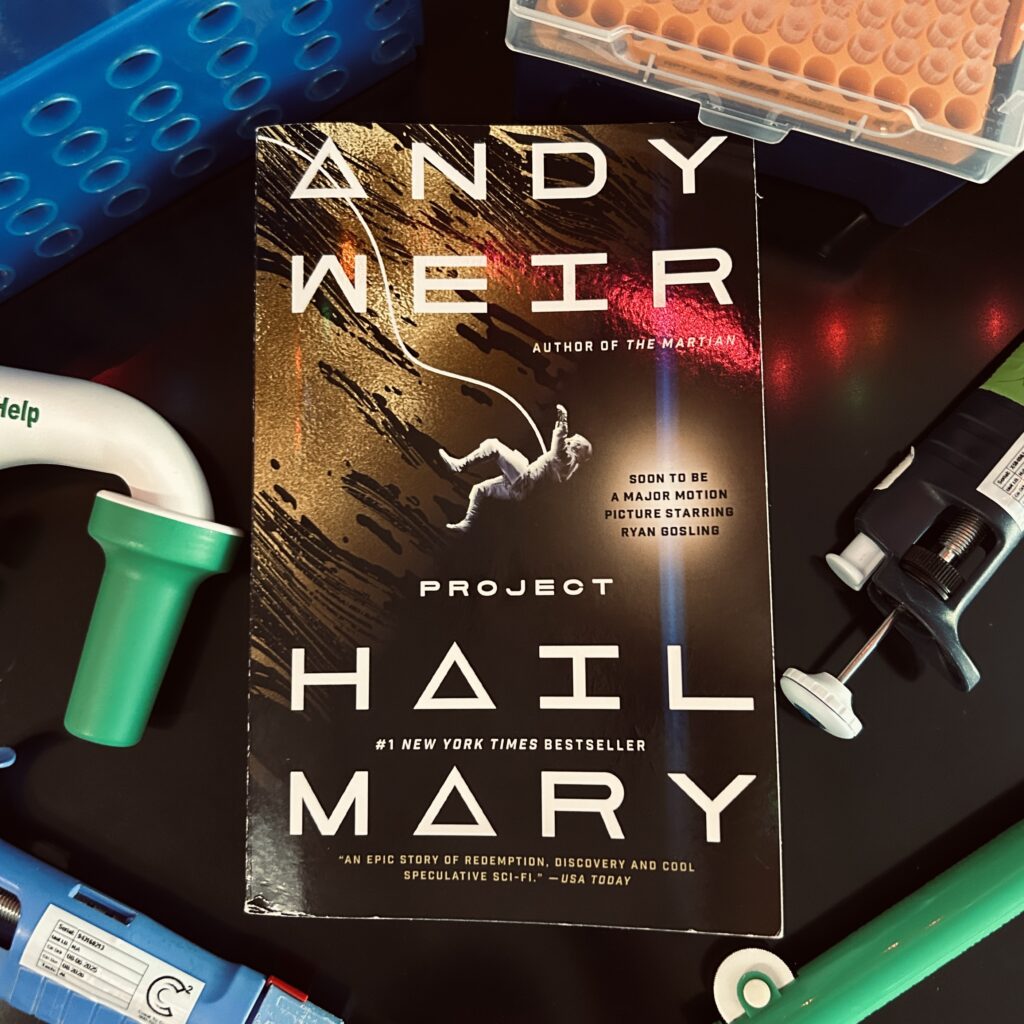
The story describes the life-or-death mission of Ryland Grace, a middle school science teacher sent to galaxies beyond the Milky Way. Grace is tasked with finding a solution to the extraterrestrial life, named astrophage, plaguing our galaxy’s sun, and the novel touches on themes of isolation and existentialism.
Grace wakes up from a coma at the beginning of the novel, but both he and the reader discover his past through moments of spontaneous memory recovery. One moment, Grace will be working on an experiment and the next he is transported to an event in his life prior to his mission. It’s a beautiful balancing act between reclaiming the past and describing the present.
My two favorite genres to read are science fiction and historical nonfiction (yes, I am a nerd and I live up to it). With “Project Hail Mary” falling into the former genre, I went into it with the fear that the science jargon would be overwhelmingly complex or unrealistic. However, I was pleasantly surprised to see that the novel excelled in both aspects, creating a story that people could engage in without doing research to enjoy it.
Weir’s biggest strength is his dialogue, where I found myself immediately entranced by his quick, razor-sharp wit. Each moment of banter radiated energy, the words flowing so effortlessly that I found myself setting my responsibilities aside to keep turning the pages.
There was never a moment where a character — whether they had a large or small role — felt flat. This is most evident in Grace’s internal dialogue, seeing how he starts as an innocent junior high teacher that uses expletives like “heck” and “darn,” only to later emerge as a man unwillingly thrust into a suicide mission once the fragments of his past are pieced together.
One of my favorite characters is Grace’s unlikely companion, Rocky. One-fourth of the way through the novel, Grace stumbles across another spacecraft and unites with a species of intelligent life who is also sent to save his planet.
Rocky is, as the name suggests, a lifeform that resembles that of a rock — aptly named by a scientist on the brink of madness from isolation. Another moment of genius dialogue emerges in how Rocky and Grace engage in conversation.
Rocky “speaks” through melodies and harmonies, which Grace assigns and translates into English equivalents. Amusingly, the two characters utilize Microsoft Excel to understand and decode each other’s languages, revealing a growing appreciation for each other’s distinct cultures. This connection is reflected in Rocky’s species’ habit of emphasizing words via repetition; the phrase “amaze amaze amaze” acted as a simple yet powerful expression of their shared triumph toward saving both of their civilizations.
When I tell you I had an emotional attachment to this rock, I am not lying. There was this looming anxiety in the back of my mind that Rocky wasn’t going to make it in the end, and that honestly tore me apart. Thankfully, there were only scares, not deaths, accelerating my page-turning pace.
“Project Hail Mary” speaks deeply to me, with biology and physics gracefully highlighted throughout each chapter. I felt like I was transported to Grace’s lab bench as I breezed through the pages, and it made me appreciate the work that I and many others infatuated with science do on a daily basis.
Although I am not on a pivotal space mission to save humanity as we know it, as Grace and Rocky find themselves in, I can relate to the pursuit of bettering the environment I live in and appreciate Weir’s ability to translate science into fiction.

 Grace Chaves
  Kailyn Collette