
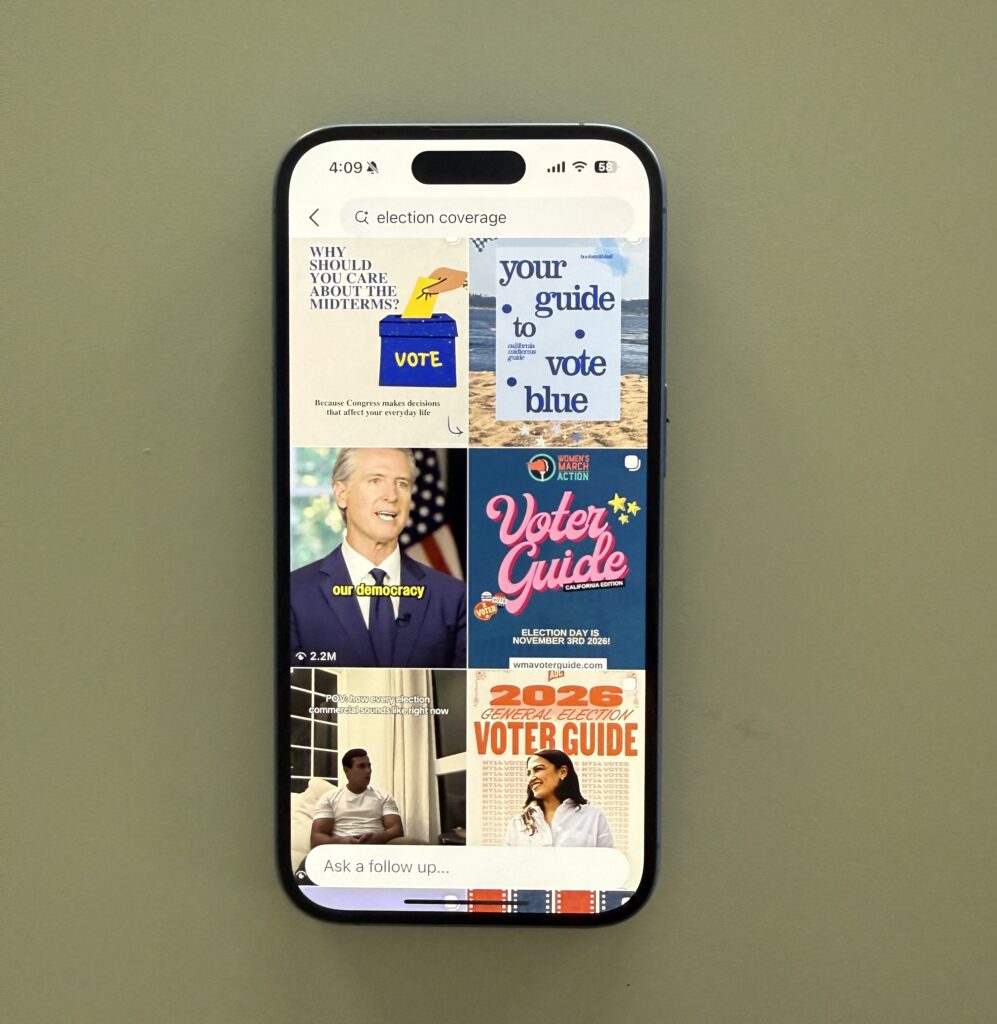
Walking across Point Loma Nazarene University’s campus, you don’t have to look long to see what students are doing between classes. Heads are down, thumbs are scrolling and social media reels keep coming. Mixed in with dance trends, campus humor and lifestyle videos are political opinions, quick explanations of policies and election updates.
For Gen Z, keeping up with the news often means scrolling through social media instead of watching the evening news or reading a newspaper. As the 2026 midterm elections wrap up, PLNU students and faculty are looking at how social media is changing the way young people learn about politics and get involved in voting.
Avery Borg, a third-year nursing major, said social media makes it easy to keep up with current events while balancing classes and campus life.
“I try to follow significant updates related to politics, but I would not say that I actively follow political news and/or election updates,” Borg said. “I have the NYT linked to my Gmail account and receive emails regarding significant political updates. However, the majority of my political information is sourced from social media (e.g., TikTok, Instagram).”
Borg’s experience reflects a larger trend among young people. The Pew Research Center found that young adults often turn to social media for news instead of relying on traditional news outlets. While scrolling through TikTok and Instagram can help students learn about current events, political scientists say relying on social media alone can make it harder to get the full picture when it comes to elections.
Lindsey Lupo, a professor of political science at PLNU, said students need to understand the difference between social media creators and trained journalists. She believes stronger civic education can help young people recognize reliable information.
“I do worry about the way that many Americans — of all ages — do not fully understand the training that goes into being a journalist and the way in which it is not a job that a person can just claim because they are popular on social media,” Lupo said in an email interview. “So my hope is that we can — as a country — push for civic literacy education in our K-12 schools where young people can learn to really discern the quality of information they are consuming, and hopefully seek out high-quality journalism.”
Even with concerns about misinformation and biased algorithms, social media can also help political candidates connect directly with younger voters. Lupo said these platforms are not necessarily a bad thing and can make politics more accessible to people who might not otherwise pay attention to it.
“I see it as a net positive, but that might just be me accepting the reality we’re in,” Lupo said regarding social media’s role in voter mobilization. “We are in this really interesting moment where candidates and elected officials are using social media in creative and engaging ways, and I think that can be a great way to get people excited about politics and to regain the trust in institutions that has plummeted in recent years.”
For students, knowing what to trust online often comes down to checking information before forming an opinion. Megan Kilburg, a third-year political science major, said she makes a point of fact-checking what she sees on social media.
“Staying curious is crucial to furthering my understanding of a topic. Social media can be a great starting point to hear about what’s going on in current affairs, but it shouldn’t be your only source,” Kilburg said. “There are a lot of qualified journalists, news sources, and research that is being done which should be used to get an understanding of what’s going on in politics.”
Keeping up with politics online is one thing, but actually getting out and voting is another. According to estimates from the Center for Information & Research on Civic Learning and Engagement (CIRCLE) at Tufts University, voter turnout among adults ages 18 to 29 tends to be lower during midterm elections than during presidential election years. Nationally, youth voter turnout has often hovered around 25% in midterm elections.
Closing that gap means doing more than scrolling through political content. Conversations with friends and encouragement from peers can also play a role in getting young people to vote. Kilburg said talking about voting with friends is one way she encourages others to participate in the upcoming election.
“I discuss the 2026 midterms by letting my friends know how I plan to mail in my ballot and asking if they want to go with me and send in theirs,” Kilburg said. “Simply discussing the importance of voting can motivate other young people to vote. Democracy thrives off of participation of many, and so it’s important to have conversations with friends and encourage others to vote.”

 Kailyn Collette