

The USS Abraham Lincoln, a Nimitz-class aircraft carrier, finally returned to San Diego on October 8th. The carrier garnered national attention in August when the poor conditions on the ship, which spent 265 days of uninterrupted time at sea, became known to the public. Around 5,000 sailors reunited with their families in Coronado, Calif., 64 of whom were fathers meeting their babies for the first time, according to NPR.
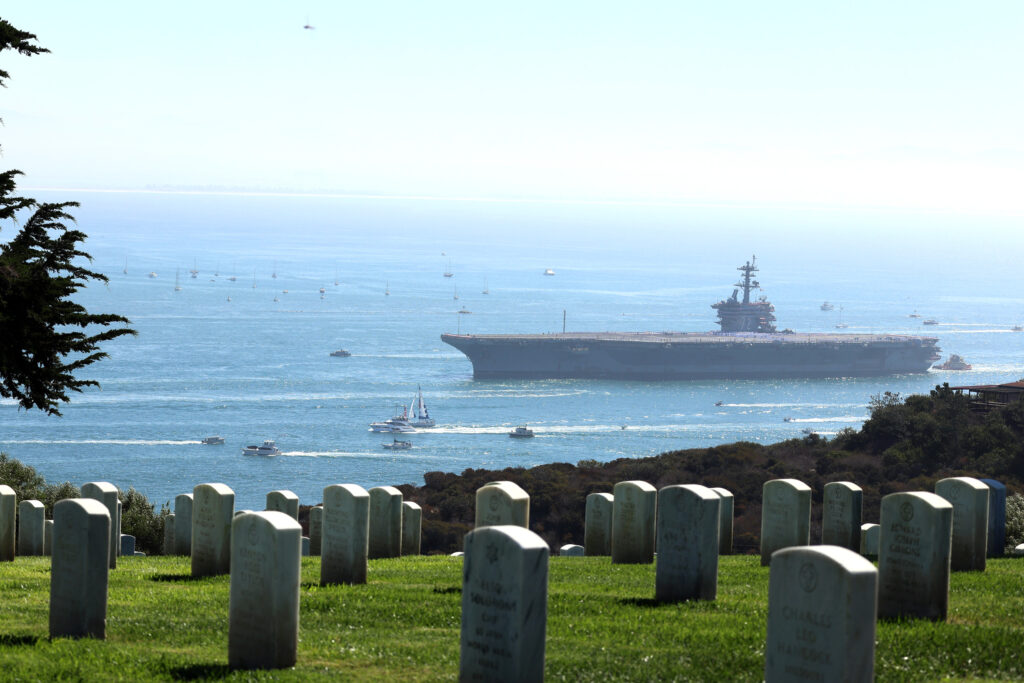
“Coming home after an arduous deployment like that, they should be nothing but proud of the work they put in,” said Denzell Washington, a third-year multimedia journalism major and U.S. Navy veteran, via text. “The time it takes to moor the ship to the pier pulling into home port feels like an eternity, but there’s nothing like wrapping your arms around your loved ones after being gone for so long.”
Four news outlets, including the San Diego Union-Tribune, sent reporters out to the carrier the night before its return. Gary Robbins, a science, military and higher education reporter for the Union-Tribune, was flown out along with a photographer. Robbins firsthand account of the final night on the ship is detailed in his article for the news outlet.
“[There were] a lot of magic moments kind of in [the experience],” Robbins said via phone call. “It was the day before they were pulling into port. At one point, someone was playing really great music on the deck, and there were no fightercraft anymore. They were coming home. And people were out on the deck dancing and singing.”
Robbins said the sailors were often in a “vacuum,” experiencing blackouts. He also said one of the fleet’s Burke-Destroyers, the Spurance, did not return with the rest of the carrier group — and is still out on deployment.
“I had been on this ship before,” Robbins said. “But not when it was going to war … she could have still been diverted on the way home if there was an emergency somewhere else. It was a feeling from people that were exhausted, thankful to be almost home, thankful that no one got killed. And what I heard from very young people … was the fact that they realized they were part of something important.”
Mental health concerns, living conditions, food shortages and congressional demands plagued the Abraham Lincoln’s morale levels among sailors. The carrier left San Diego last November, and was rerouted after over 200 days to the Middle East to support U.S. operations in the war with Iran in a mission called “Operation Epic Fury.” CNN and the BBC reported on the news that a sailor went overboard in August and was safely rescued within an hour. Later, it was revealed to the public that there were eight confirmed attempted suicides across the carrier strike group. Family members of sailors also leaked texts from their loved ones, recounting severe infrastructure failures on the ship. Examples included failed plumbing, inconsistent wifi connection, limited fresh food and unorganized mail delivery.
The controversy was only amplified when President Donald Trump was asked about the issue, and responded that he was of the opinion “the deployment was not nearly long enough.” This commentary enraged military families, lawmakers and sailors alike.
U.S. Defense Secretary Pete Hegseth flew out to the carrier a few days before its return, and presented them with the Presidential Unit Citation, the highest honor a unit can receive, according to The Hill. According to the Department of War, the Abraham Lincoln “supported 40 days of major combat operations, involving nearly 4,000 combat sorties from the air wing. Task force units destroyed more than 100 Iranian drone, missile and small boat attacks against the force, with the wing delivering more than 1.5 million pounds of ordnance on thousands of targets in support of operational objectives. This concentrated firepower significantly degraded Iranian navy capabilities.”

 Zoey Peters