

In an office with every inch covered in the historic symbols of his craft, Bill Clemmons prepared to pass down a Chinese Guzheng, West African Ghanaian drums, gambas and much more to incoming faculty.
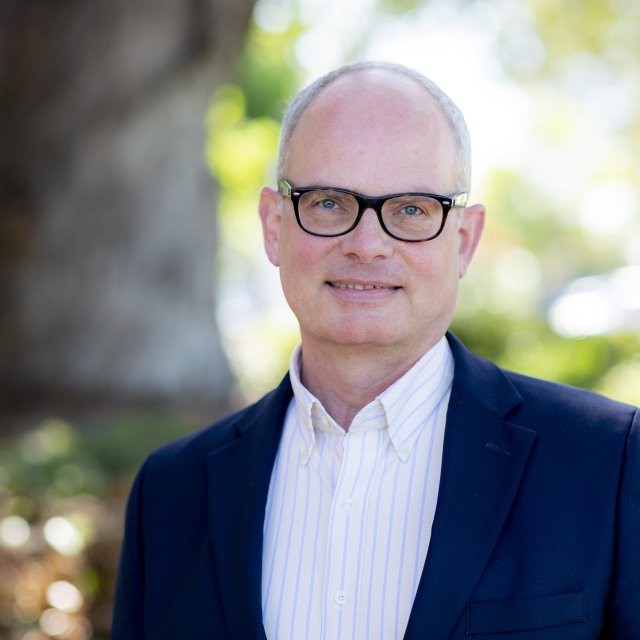
Clemmons has served as a professor of music theory at Point Loma Nazarene University for over two decades. When he arrived in 1996, the Cooper Music Center was just being established. Since then, the program has been built from the ground up, shaped in part by his contributions, including the development of computer labs, recording studios and the addition of the commercial music program, now the department’s most successful offering. In addition to music theory, he has taught courses in orchestration, form and analysis and music history.
Beyond his work within the university, Clemmons’ time in San Diego has also contributed to the planting of two churches, one being Mid-City Church of the Nazarene.
The Point sat down with Clemmons to reflect on his time at PLNU as he prepares to retire after the spring 2026 semester.
The Point: Do you have a favorite memory or most impactful moment from your time on the faculty?
Bill Clemmons: I guess one of the things is when you see your students follow in your footsteps. So I’ve got students who are also teaching what I teach at other universities. … That’s probably the biggest one, because it’s such a hard career. It’s so hard to get a job. And to see them go on and go through grad school and be successful and move into that career, that’s really satisfying.
TP: What legacy do you hope to leave behind at PLNU?
BC: I think what we’ve built. For instance, all of these instruments that you see all around you, this wasn’t here 15 years ago when I started working. It’s the fact that someone else is going to come in and realize that they’ve got something to work with. Or the two recording studios downstairs or the commercial music program, which has been running now for its ninth year or so. To see all of those things successful and available for the folks that are coming after me … it’s pretty exciting to see that they’ve got a lot to work with.
TP: What will you miss the most about being a professor?
BC: Just hanging out with students probably is the main thing. The thing that I won’t miss is teaching at 7:30 in the morning, five days a week. I’m [an] early morning person. So I’m the one that opens the building and turns on the lights … but it is very meaningful to start because I’ve got first year students, and it’s really meaningful to have them from the very first day that they set foot on campus and getting to watch them graduate. I think that’s probably what will be missed out on.
TP: If you could go back and give your younger self one piece of advice, what would it be?
BC: Pacing. When you first start out, it’s pretty frantic. You’ve got six years to prove yourself. If you don’t prove yourself in six years, you get let go. So that’s the tenure process. … And so we all know that you shouldn’t be freaked out about it. But I mean, my goodness, you’re trying to do scholarship, you’re trying to raise a family, you’re starting a brand new job, you’re teaching crazy hours. And it’s hard to balance all of that stuff. So, probably the main thing would be to take a breath, settle down, enjoy the process instead of feeling so frantic, because it is a lot of work.
TP: What are you most looking forward to in retirement?
BC: Our family is scattered around. We have four kids, they live in the Bay Area, Virginia, New York and the Netherlands. So we don’t have family in San Diego anymore. So spending time with grandchildren, that’s pretty big. But because they’re scattered all around, getting to them involves a lot of travel. When you teach at 7:30 in the morning, five days a week, it’s really hard to have that kind of flexibility. But, the ability to see, spend time with grandchildren, be part of their lives, that’s really important.

 Belen Palomino Young