

Editor’s Note: “Stories from strangers” is a bi-weekly column that features people regularly seen on campus who aren’t affiliated with Point Loma Nazarene University. This series seeks to share their stories, understand what draws them to PLNU and serve as a reminder that every stranger has a story worth hearing.
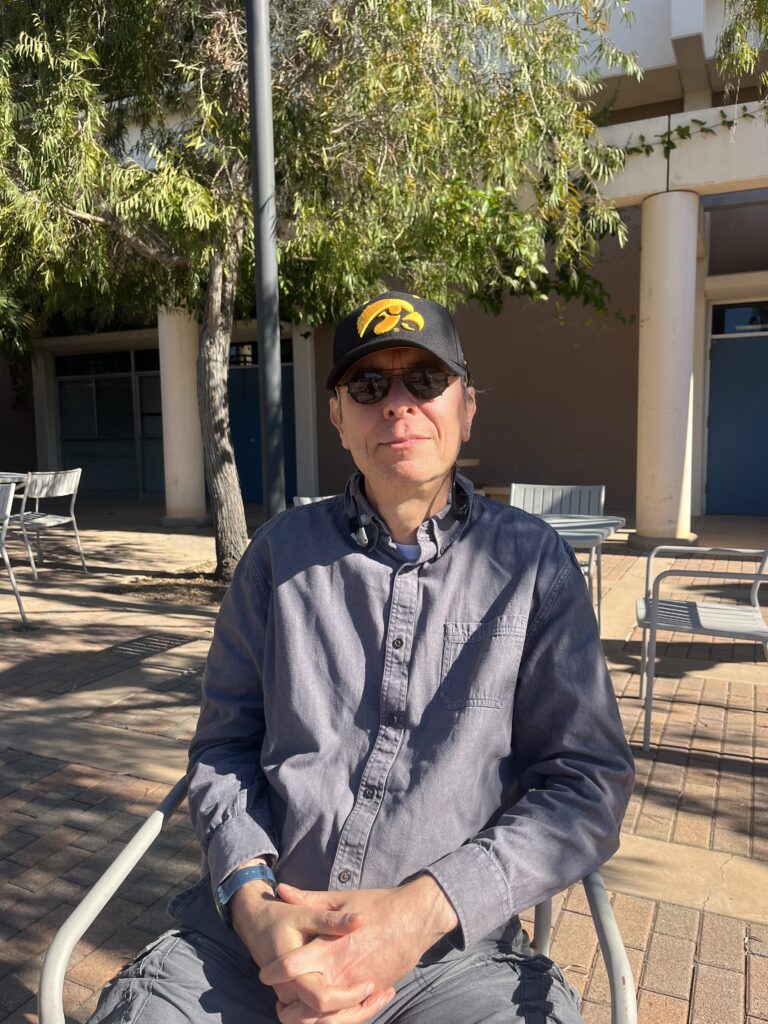
Gerrit Melles is a citizen of the United States and the Netherlands, and came to the United States in his early 20s to stay with a host family in Point Loma. He was connected with a family of five after arriving for a research assignment that was required to complete his studies. Melles’ stay with the family was supposed to last only two weeks until he found his own living arrangements; however, it turned into two years.
Melles was born in The Hague, Holland, and followed in his father’s footsteps by becoming an ophthalmologist. He attended Leyden University (spelled Leiden in Dutch) before coming to San Diego to complete a portion of his studies. Melles continues to travel between Holland and San Diego, spending about half of the year at each, while still living just a few minutes away from Point Loma Nazarene University.
His route for his walks isn’t always the same, he said, but he can often be found walking the campus when the bustle of students has quieted down, or through the neighborhoods.
The Point: When did you come to the U.S., and what was the most challenging thing to adjust to?
Gerrit Melles: The thing that stuck with me the most was that in high school, you learned English, German, French. It was routine for us. So I think I had about three years of English or so when I came here, but when the family picked me up at the airport, I didn’t understand a single word they said. I knew it was English, but it is the accent. The accent was the hardest part for me when I came.
TP: What career did you choose to go into?
GM: I am an eye doctor in the business of coming up with new surgical techniques. I’m not the type of person to want to do the same thing for 25 or 30 years; I get bored. I think it’s fun to find things to change, that’s why I like to look at what surgeries and techniques work and which ones don’t.
TP: What is the main difference you have noticed working in a field in two very different countries?
GM: My first piece of advice is to go to a different country. Go to a different country because you will realize, “I think so differently from these people.” … The Americans are far more eager to work on something new and to develop things … Think about your vice president; he was the poorest guy, and he went all the way up. Whereas in Europe … it’s difficult to go from one class to another.
TP: Would you say you run your organization with more American values or values you developed in Holland?
GM: Holland is much more authority-driven, whereas how I run my organization … If you’re in America, you’re probably not aware that most of the people living in other countries do not have the same opportunities. They can look into education, but they are not allowed to be creative. If you live in a country under a government that does not allow you to have your own opinion, you can’t come up with any idea that is out of the ordinary. The biggest difference with the U.S. is that you can make your future, basically. In a majority of countries, it’s better to keep your mouth shut or to make yourself small.
TP: What would be your advice for college students who are looking into picking their careers, and do you believe that we fall into the career that is meant for us?
GM: I’ve learned that the younger you are, the less of a threat you are. If you are in high school and you go into a company to watch how it works, most likely you will be welcomed. But if you’re 40, they are going to say, “What is your agenda?” My advice would be to try to observe and absorb as much as you can. … it’s better to expose yourself to the trade. I also think, in the end, that people more or less end up where they belong.

 Olivia Roberts
  Ava Bailey-Klugh