

Editor’s Note: Staff writer Kate Williams is a part of the Honors Cohort that attended “The Screwtape Letters.”
Playwright Max McLean brought C.S. Lewis’ “The Screwtape Letters” to the stage at California Center for the Arts last week. Twenty Point Loma Nazarene University Honors Program students and faculty attended the theatre adaptation. The Christian apologetic production, the first Honors event of 2026, earned its praise from PLNU attendees for its dedication to Lewis’ original 1941 story while incorporating a modern twist.
The Escondido theatre sold over 1,500 tickets for the play on Jan. 18, selling out quickly after the play’s announcement in the winter months. Ben Cater, the director of the Honors Program, grabbed 20 tickets to the popular play while browsing for a spring Honors event in the theatre. He said that the timing worked out logistically and that Lewis was a perfect scholar for the group.
“C.S. Lewis is one of the great Christian academics of the 20th century,” Cater said.
He valued “The Screwtape Letters” particularly for its bravery in a society where many explain away every mystery with science.
“It’s one of his most provocative books,” Cater said. “It really does challenge sort of a modern mindset which believes that the only thing that is really real is that which can be measurable or sensible. But what the scriptures, according to C.S. Lewis and many Christians, believe is that there is a world out there that is beyond our senses.”
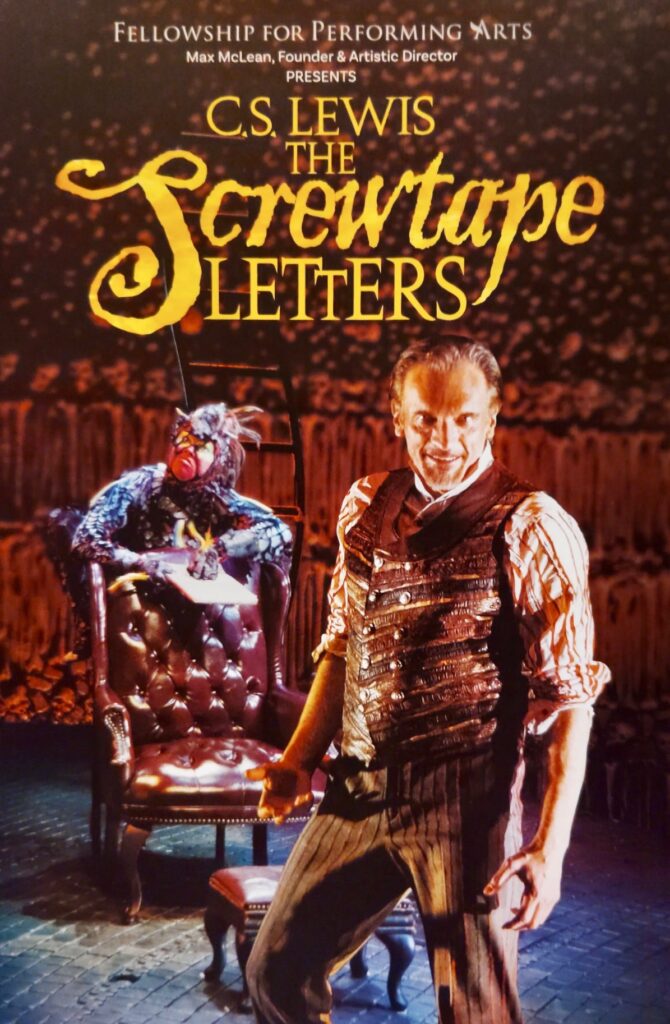
While Cater urged his students to ask themselves what they believe about spiritual warfare, “The Screwtape Letters” wasn’t an in-class read for the Honors students. Nico Gamboa, a third-year biology-chemistry major, checked out the book in Ryan Library a week before the play in preparation. Gamboa said the book increased his self-awareness with its creativity and dark humor.
“It had a lot of things that called out aspects that we all do,” Gamboa said. “Like, yeah, I do that, I should probably work on that. It’s very biting in that way.”
Brent Harris (who played Scar in “The Lion King” national tour) starred as the senior demon Screwtape, and Tamala Bakkensen played Screwtape’s secretary demon Toadpipe.
The play, created in 2005 when the playwrights bought the rights to “The Screwtape Letters,” took five years to become the masterpiece it is today. The playwright, Max McLean, emerged at the end of the performance for a post-show 10-minute talk to discuss the process of adapting the theological classic.
“It was a matter of being clear, streamlined and as close to the book as possible,” McLean said.
This meant reducing 75-word Lewis quotes to a maximum of 20 words.
While McLean stayed faithful to the original material, he made minimal changes to modernize the piece. For instance, “Beyond the Nest’s” article shared that Screwtape’s character was inspired by Hitler’s Reichstag speech in 1940, which Lewis found to be full of lies told with complete confidence. McLean changed Lewis’ references, bashing the Germans in World War II to “terror.”
McLean also added a few modernizations for the sake of humor. For instance, when talking about how Wormwood should encourage his patient to sloth to regain hold of him, Harris imitated clicking a remote controller and scrolling on a phone. Evan Gonzalez, a first-year English major, appreciated these modern moments, as they made the 20th century story more relevant and entertaining.
“What stood out to me was the production of it, the music and some more modern references, mostly with the hand gestures,” Gonzalez said. “He imitated scrolling on a phone when he was talking about distraction, and I thought that was pretty funny, and something which was definitely not in the original book.”
Elizabeth Gray, a third-year history major, also appreciated the humor of McLean’s adaptation.
“Humor is a good way to make things feel more approachable or even soften the blow of heavy topics, and for something like forces of darkness, that can be a good thing because people have strong feelings about religion,” Gray said.
For me, “The Screwtape Letters” acts as more than a staple of academic Christian apologetics. Within the pages and on the stage, the story issues a warning to audiences across centuries that demons may not simply be metaphors for traumas living inside of our psyche, but rather real evil forces working feverishly to pull us away from God. Cater reflected on Lewis’ idea with gravity.
“Screwtape is something real that is out there, that is having a real conversation with a lesser devil and is very, very intent on undermining Christian belief,” Cater said. “So if they capture that in a dramatic way, then I think they’ll be faithful to what ‘Screwtape Letters’ is actually about.”
