

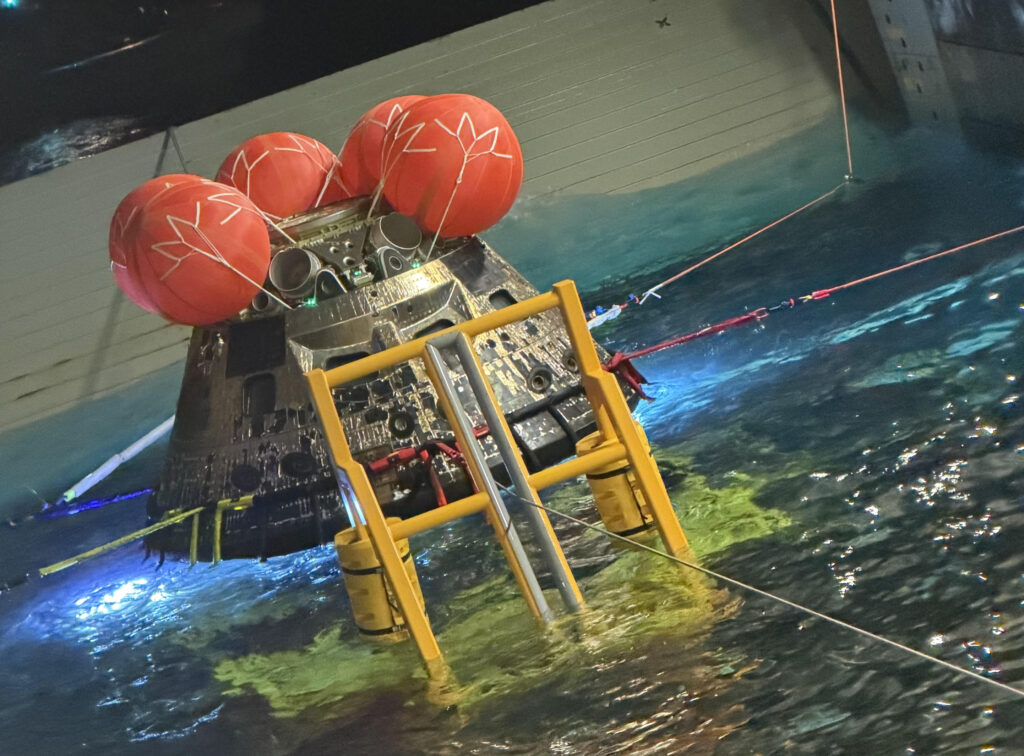
NASA successfully launched the Artemis II mission, which sent a spacecraft to go around the moon for the first time since the Apollo 13 flyby in 1970. Artemis II safely landed off the coast of San Diego, where the USS John P. Murtha, a San Diego warship, recovered the astronauts.
On April 1, NASA launched Artemis II from the Kennedy Space Center in Florida with the mission to complete a flyby around the moon. The spacecraft reentered the atmosphere on April 10, landing in the Pacific Ocean. The crew onboard the USS John P. Murtha was ready at the landing point to recover the astronauts and provided them with medical care before flying them to shore.
Rick Kennedy, a professor of history at Point Loma Nazarene University, watched the Apollo 11 launch in 1969, which was the first manned NASA mission to land on the moon.
“I was 11 years old, and I was the perfect age,” Kennedy said. “Because you’re a kid, you know, at age 11 to 12, I mean, I made models of the spaceships.”
Kennedy said he watched on TV in the summertime with his parents.
“Neil Armstrong was the hero of heroes,” Kennedy said. “NASA is the smartest people in the world, you know, in 1969.”
Kennedy didn’t watch the Artemis II launch but said he believed that some of the excitement was taken away because of technological advances, which have made traveling to space less adventurous.
Vivyan Gripp, a third-year mechanical engineering major at PLNU, watched the Artemis II launch. Gripp considered working for NASA after graduation, but changed her mind after NASA stopped launching spacecrafts into space. She said watching the launch gave her hope and inspiration for her future career as an engineer.
“Space is what got me into my major. It is what inspired me to be an engineer,” Gripp said. “To get to see a launch and successfully — like to say, ‘Hey, we’re going back to the moon, like we’re going to land on the moon in the next few years.’ Like that is just a crazy sentence, even of itself.”
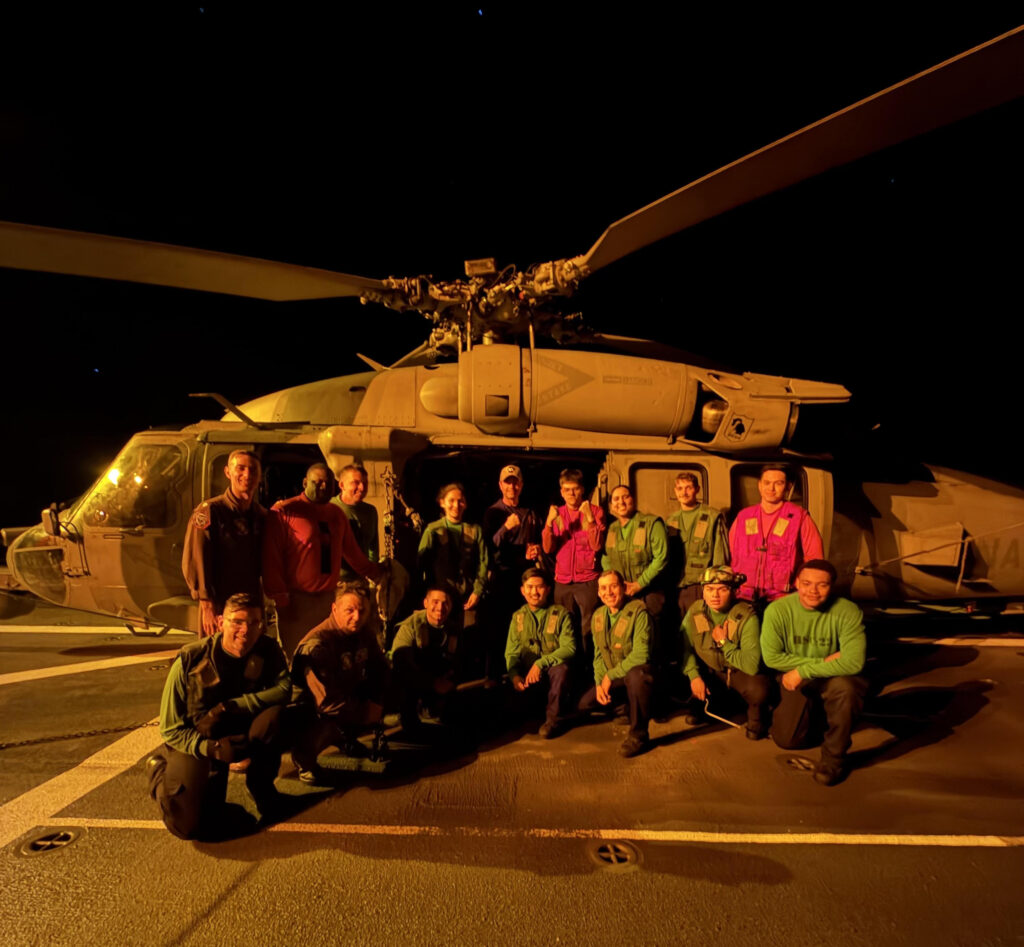
On the USS John P. Murtha, the crew consisted of workers from multiple commands on the Naval Base Coronado, including Helicopter Sea Combat Squadron 23 (HSC-23). From the command, Taylor Holland, a lieutenant in the Navy and helicopter pilot at HSC-23, flew the helicopter with the camera that livestreamed the capsule landing for the world to see.
“Honestly, I was just flying in a circle once the capsule landed,” Holland said. “We were watching it the entire time. So that was an awesome experience.”
Holland has been a part of the Artemis project within HSC-23 since she arrived at the command in 2024. She hoped to be a part of the crew on USS John P. Murtha when the capsule landed along with the 200-300 NASA personnel working to ensure the capsule landed safely.
“Everyone’s kind of crunching numbers on their laptops, making sure everything’s going the way that it’s supposed to be going,” Holland said. “So I think the behind-the-scenes aspect and how hard everyone was working on their own specific component, and then it all coming together for successful recovery was really great.”

 Sydney Brammer
  Carson Dillon