

Editor’s Note: This article was updated on Feb. 2 with the correct century mentioned in the first paragraph.
The average student at Point Loma Nazarene University might attend a morning service in Brown Chapel, line up for communion, share a coffee with friends and go about their day, enduring long classes and cramming in late-night study sessions. Few are probably thinking about 19th-century ministers or Los Angeles revivals.
PLNU proudly embodies the Nazarene tradition in its name, but for some, it doesn’t always feel like a campus dedicated to a particular Christian denomination. Many students don’t come from Nazarene churches, and the number of faculty that does is becoming smaller. Many come from Catholic or Orthodox backgrounds, while others simply identify as Christian.
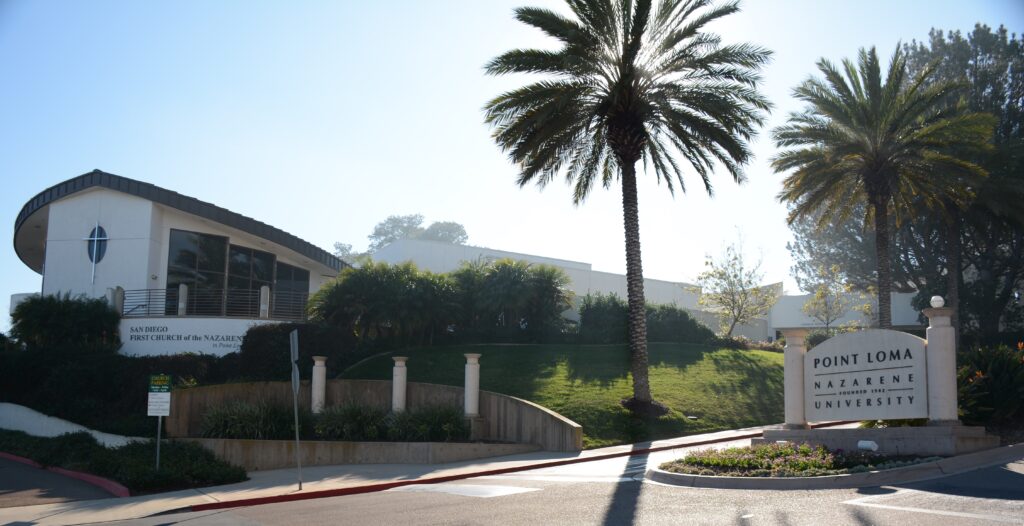
But underneath the many different traditions of students and faculty lies PLNU’s rich Nazarene history that shapes its goals, learning and community.
The Church of the Nazarene was formed in 1908 as a branch of the Wesleyan movement, and emphasizes a transformed heart and care for “the least of these” — a practice that remains active on campus today, through programs such as Community Ministries and Ministry with Mexico.
Mark Mann, PLNU professor of theology and director of the Honors Scholars Program, outlined the philosophy of the Nazarene tradition.
“There was this deep commitment to a spiritual life that was centered in community and in an individual kind of personal relationship with God,” Mann said.
Followers of this Nazarene group met in small accountability groups, shared communion, fasted, visited prisons and raised money for the poor.
They believed that “true religion was not in obeying certain things or even believing certain things, but in love for God and love for neighbor,” Mann said.
As they grew into a denomination, it also developed into the “holiness movement,” spearheaded by Methodist minister Phineas Bresee. In 1895, Bresee and H.P. Whitney founded what became the Los Angeles First Church of the Nazarene.
Bresee dreamed of a college that combined academics with a focus on holiness and social concern. He never had the time to start one until a small prayer group, now remembered as “the Unknown Six,” approached Bresee in 1902 with a proposal for a Bible college in Los Angeles.
“They asked him to be president, and this is why we call Bresee the first president of [what became] Point Loma Nazarene University,” Mann said.
Lincoln Zdunich, a second-year Christian studies and philosophy double major, said that his theology classes largely remain true to the Nazarene tradition, especially aspects of the holiness movement.
“I would say that things like the Wesleyan holiness movement are very common here,” he said. “Our classes definitely are propagated by a lot of Nazarene theological history.”
The college drastically changed throughout the 20th century, starting as Pacific Bible College in 1902, moving to Pasadena in 1910 and finally to San Diego in 1973.
To establish itself in its new community, the school began calling itself Point Loma College, then soon after changed its name to Point Loma Nazarene College to maintain its denominational commitment. It eventually became a university in the 2000s.
“As the school elevated its stature, it became attractive to more and more people who were not Nazarenes,” Mann said. “The school … came to realize that if we’re going to grow, we need to start hiring people that aren’t Nazarene, because there aren’t enough Nazarenes to fill all of the faculty positions.”
Mann commented on this diversification of denominations on campus.
“When I came in 2008, I’d say 60% of the faculty and 10 to 15% of the students were Nazarene,” Mann said. “Probably in 1975, 90% of the students and all the faculty were Nazarenes … I would say we’re down to about 20% Nazarene faculty, and maybe 2% to 3% Nazarene students.”
Zdunich said he believes the university does an especially strong job of bringing together many different Christian traditions during chapel services.
“It’s difficult when you have 3,000 people who all come from very different backgrounds, some of which aren’t even Christian, and they have to attend [chapel],” Zdunich said. “It’s interesting trying to tackle that.”
Despite a drift away from PLNU’s original heritage, Mann does not see these changes as entirely negative. He said Nazarene values are still embedded in the university’s operation.
“It’s not as important that we call these things ‘Nazarene’ anymore,” Mann said. “It’s become so much a part of the DNA of Point Loma that, God bless us, that will always remain.”
Michael Lodahl, PLNU professor of theology and world religions, said the opportunities for students to attend chapel, engage in fellowship groups and serve the larger community are all ways that the Nazarene tradition informs the university operations.
“There is no question that Nazarene higher education has always held a deep commitment to conjoining piety and learning,” Lodahl said in an email interview.
Mann said that PLNU is an inclusive community, welcoming those who might not share the same beliefs. He said that what should be most emphasized is a relationship with God, not someone’s denomination.
“It’s our call to holiness, to be set apart for God, and that being manifest in a vital relationship with God is the single most important thing in life — for us as individuals and for us as a community,” Mann said. “Everything else is secondary.”
Lodahl emphasized Wesley’s theological focus on the biblical proclamation that “God is love” (1 John 4:8, 16).
“At our best, that is where we begin, and everything spins out from there: God is ‘pure, unbounded love’ (in the words of Charles Wesley) and God’s calling upon us all is to be open to receiving and sharing that amazing and everlasting love,” Lodahl said.
This unbounded love for God and neighbor remains a central vision at PLNU. Even if fewer students could name John Wesley or explain the holiness movement than in previous decades, Mann believes they still participate in that tradition whenever they engage with faith on campus.

 Kailyn Collette
  Olivia Roberts