

Editor’s Note: Sofia Murillo is a third-year psychology transfer student at PLNU, and is passionate about topics related to student wellness and equity on campus. After graduation, she plans to pursue a career in speech-language pathology. The opinions expressed in this article do not necessarily reflect those of The Point.
The rhythm of campus life looks different for every commuter at Point Loma Nazarene University. Some students push through the chaotic morning rush, others sacrifice sleep in an effort to beat traffic, and many spend long stretches of time on campus because their schedules have long gaps. Students who live on campus, however, can usually walk or take a short shuttle ride to class, which gives them easier access to campus and far fewer barriers in getting to class.
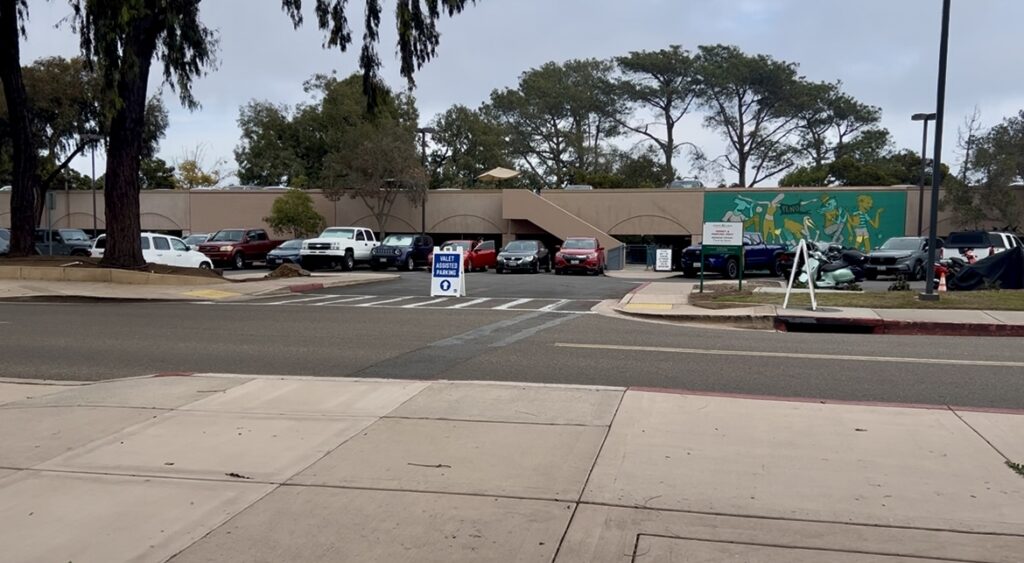
As commuters work through these barriers to arrive at class on time, one thing remains clear: The university has the opportunity to support these students through a more practical and equitable scheduling system.
Luke Friesenhahn, a first-year business administration major who commutes from Ramona, said that managing his schedule around long-distance travel has been one of his biggest challenges as a new student.
“I have to wake up at 5:15 on average every morning,” Friesenhahn said. “Some days it feels like a full-time job.”
Friesenhahn said his commute can reach 1 hour and 45 minutes when traffic is heavy, and even the most organized and time-conscious plan can be interrupted by unpredictable delays.
“You cannot prepare for accidents, slowdowns or freeways being closed,” he said. “There were days I left at the same time as always and still showed up late to my 8:30 [a.m. class].”
His experience reflects what many PLNU commuters describe. A single early morning course can shape student wellness by affecting how much sleep they get, how rushed their mornings feel and how ready they are to engage once class begins.
“It is not easy,” Friesenhahn said. “Some days I get five to seven hours of sleep, and it all depends on whether I sleep well that night.”
Late evening classes bring their own difficulties, too, since little time is left for homework or family responsibilities.
“Late evening classes are really difficult for commuters,” Friesenhahn said. “If a class ends around 8:45 [p.m.], I do not get home until about 9:30 [p.m.]. That leaves me almost no time to do homework or spend time with my family.”
One way the university could support these students is by granting commuters priority registration, so they have a better chance at choosing times that work for their travel. According to Cheryl Gaughan, director of records for traditional undergraduate programs, the records office does not decide which groups receive priority registration.
“Priority does not mean first. Not everyone with priority can be first at the same time,” Gaughan said in an email interview. “It just means earlier.”
Gaughan also said that priority status does not guarantee an earlier window.
“Priority registration does not always result in an earlier registration because the student may already have a higher priority for another reason, such as being a final semester senior,” Gaughan said.
This shows that the existing system already has the flexibility to include more student groups in priority registration. Several universities offer priority registration to students with limited scheduling flexibility. The University of Illinois Urbana-Champaign provides it to students who need specific scheduling accommodations, UC Riverside extends it to students with mobility or medical constraints and California State University, Monterey Bay uses it to support students whose schedules are restricted.
Recognizing commuters in this way would allow PLNU to align with practices commonly used across higher education and would better acknowledge the barriers students face when trying to register for classes that fit their daily realities.
Because the structure is already in place, giving commuters priority registration would not require rebuilding the registration system or creating new procedures. It would allow commuters more equitable access to course times that fit the practical demands of their daily commute.
“Based on the traffic and parking situation, we’re getting the very short end of the stick,” Friesenhahn said. “I think priority registration would be really useful, so commuters don’t end up in those kinds of situations.”
