

Trigger warning: This article mentions suicide.
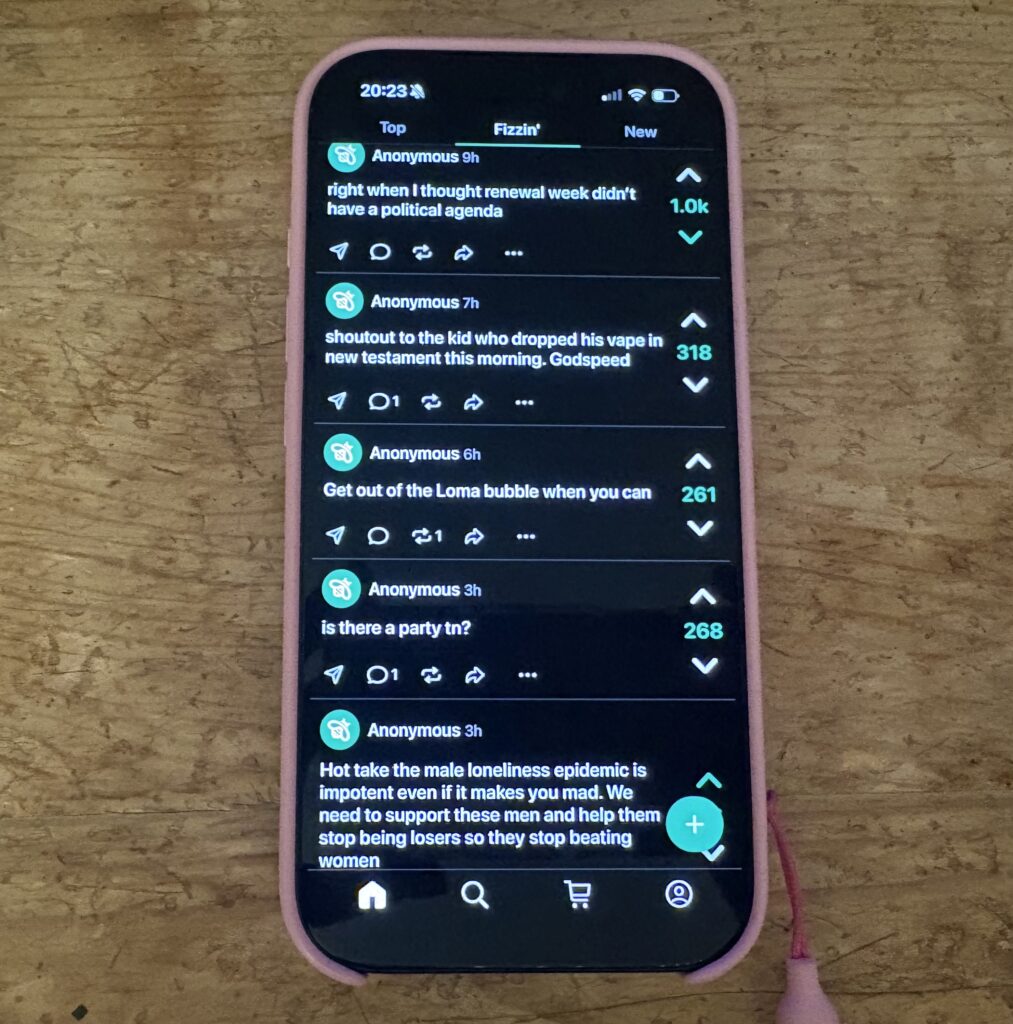
Many students at Point Loma Nazarene University have heard of it, and over 1,500 of them are active participants on it. Fizz, an anonymous social media app for college campuses, has become a trend, which has caused concern among the PLNU community.
On Jan. 30, 2023, The Point reported that as students walked down Caf Lane after chapel, “a smiling group of donut-wielding students awaited them.” For every student who downloaded Fizz, this group would hand them a donut and a bucket hat.
It’s been three years since then, and now the app is again a topic of discussion. As more colleges have embraced the app, more controversy has arisen, both on campus and at other universities.
Fizz is an app that any college campus can use when a student requests it on Fizz’s website. It’s formatted similarly to X, except every post is anonymous. A PLNU student who is a Fizz moderator and requested anonymity to keep their identity on Fizz confidential said there are about 25-50 moderators on the app to keep it safe.
“[Fizz] users can report certain posts on Fizz, and any time that gets reported, any type of moderator can go on and check and decide if it should stay on, or if it should be deleted,” the moderator said.
Some students get bullied on the app, they said.
“There are phases of certain students that get bullied from time to time,” the moderator said. “It has been very serious more recently with a lot more information of students being publicized, but most of it is less serious … because a lot of people just post things just to get a reaction.”
The moderator said that even after deleting negative posts, the bullying “always comes back.”
Trinity University in San Antonio, Texas, realized that this app may be causing harm, according to an article from their student newspaper, Trinitonian. Trinity’s Dean of Students, Jessica Edonick, said that a student stood on a balcony on campus early in the fall 2025 semester contemplating suicide. According to Edonick, the student had experienced bullying on Fizz. This was not an isolated incident — another student at Trinity attempted suicide in the spring of 2025, also because of the app.
Despite the bullying PLNU’s Fizz sometimes sees, the moderator said that so far, there hasn’t been anything as serious as Trinity University has seen. They said that if Fizz made the app so that you have to register with your student email, it would be easier to track down people and take down negative posts.
A third-year student at PLNU, who requested anonymity for fear of being bullied, said that while they think Fizz can be comical, it can also be negative.
“I think this year [Fizz] has gotten to another level and people have become very disrespectful,” the student said. “And I don’t think that’s what Point Loma stands for.”
The student encouraged students to show kindness to one another.
“We’re supposed to love thy neighbor, like the Bible says,” they said. “Just be kind. Love one another.”
Mabry Cole, a second-year graphic design major, had a temporary moment of fame on Fizz. After dressing up as a character from the 2004 animated film “The Polar Express,” a picture of her began to circulate. While she said she didn’t have a problem with it and overall has had a positive experience with the app, she said she could see how it could be problematic.
Cole suggested that Fizz establish safeguards to prevent harm in the future.
“[On] TikTok and Instagram, there are words that you can’t use — they’re restricted,” Cole said. “I feel like if those were in place in advance, just having certain trigger words … that could definitely help with that.”
Connor Mathisen, PLNU director of community life, said that he’s heard of instances of bullying and harassment on Fizz. He said that because of the anonymous nature of it, it’s challenging for PLNU to take any action.
“PLNU certainly has the ability to provide support and care for students who have experienced bullying or harassment on Fizz,” Mathisen said in an email interview. “I always recommend that students reach out to the Counseling Center on campus or other trusted staff members for support. I also urge students to look out for one another and provide support for peers that come to them struggling with bullying or harassment.”
Mathisen encouraged students not to use the app at all.
“Hold each other accountable, and engage with one another intentionally,” Mathisen said. “Seek out those who are desiring the connection that [Point Loma] offers. That takes the courage to stand out in a crowd that wants to remain anonymous.”

 Ava Bailey-Klugh
  Adee Tulcan