

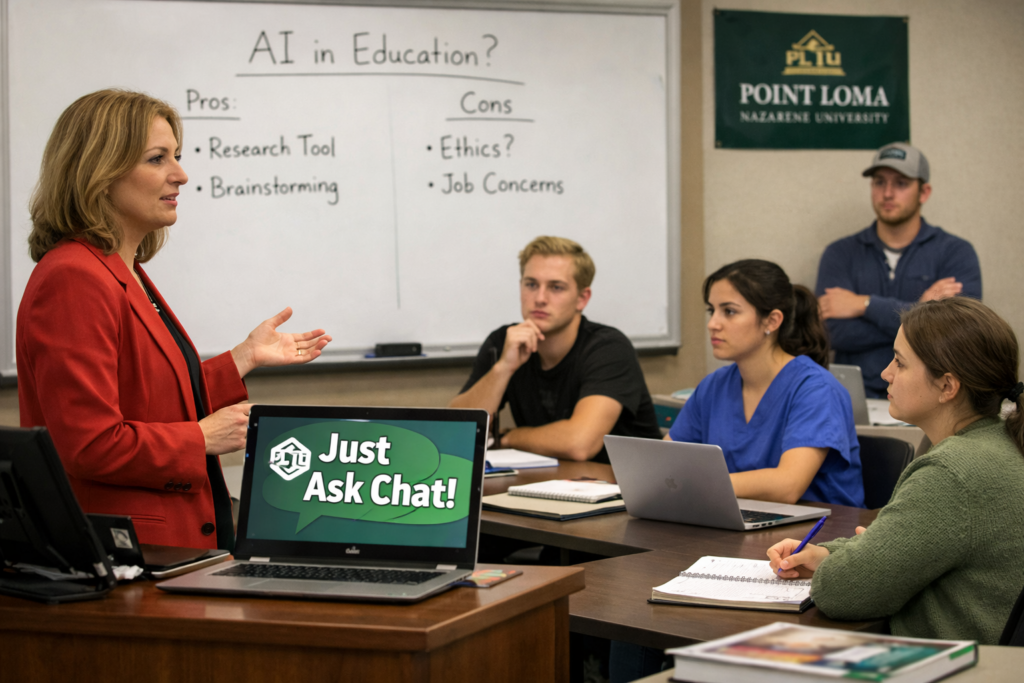
“Just ask Chat” is a phrase that has become a staple on the Point Loma Nazarene University campus. Since its release to the public in 2022, ChatGPT and other generative AI platforms have established a large presence in many university classrooms. Students and professors across disciplines at PLNU are still trying to understand if and how they should be using AI in the education process.
Maria Voss, a political science professor at PLNU and a lecturer at San Diego State University, said she has begun using AI to see what kind of answers her students might be getting from it, and to compile her own research.
“I have mixed feelings about it,” Voss said. “On the research side, I have started using it, and I think it is really helpful, but sometimes I do think I am losing something.”
Voss said she has noticed a divide between the institutions she works for. The emails and conversations within her department at PLNU have been more pro-AI, showing an intentional push to understand, use, or integrate the technology, while her department at SDSU feels more resistant, she said.
Lily Thompson, a second-year international studies and philosophy double major, said that from a student perspective, AI use within the political science department has been presented as a brainstorming tool or starting point, but that students must go on to produce their own work.
“I don’t really see the service provided by AI as necessary to my completing of assignments,” Thompson said in a text message interview. “I personally feel more satisfied knowing that I completed assignments entirely on my own.”
Thompson, who hopes to pursue a career in law, said she is concerned about AI replacing entry-level positions within the field — including jobs that review data and case files.
“This is a frightening reality,” Thompson said. “A field like law requires a human touch and the ability to recognize how context is shaping behavior and might require untraditional solutions.”
Within her own department, Thompson said she felt a desire for more clarity surrounding the department’s policies on AI use, and that she appreciates the stances she’s seen from her professors, but wants a deeper understanding of why they have come to those conclusions.
“It’s often understood as being bad,” Thompson said. “But there isn’t much talk on why exactly it’s not the best option.”
Kaylyn Stringham, a second-year accounting major, said most of her business professors encourage AI use, just not in place of independent work. Her professors have introduced and encouraged the use of platforms like Notebook LM to study more efficiently, which she said has helped her.
However, despite using it as a study tool, Stringham said she still lacks an understanding of how exactly AI is being used outside of the classroom.
“I feel like they don’t really tell us a lot about how it’s being used in the business world,” Stringham said. “But maybe that’s something they address more in higher-level courses.”
Reaves Dayton, a fourth-year nursing major, said that in her program, she is often told not to use AI at all, but she still does.
“Obviously, we’re not putting identifiers — we keep HIPAA even with Chat [GPT],” Dayton said. “But we kind of put our information in and then ask if we have the right goals for our patients.”
Dayton said that using it to make sure she is not missing anything with her patients has been helpful in her nursing education.
Other students resent the use of technology in classrooms. Blake Bridges, a second-year environmental studies major, has experienced mixed expectations surrounding AI use from his professors and would prefer not to use it at all.
“We don’t need AI, and our access to it should be removed,” Bridges said in a text message interview. “If everyone else had to graduate without AI, why don’t we?”
There are faculty on campus who share this skepticism. Margarita Pintado Burgos, a Spanish professor at PLNU, said that the first thing she tells her students in class now is that she stays away from AI.
She is currently teaching creative writing, nonfiction and advanced-level Spanish classes, and said she does not see the need for it. All of the brainstorming she has her students do in person rather than at home with AI.
“I have a little bit of a moral stance against the use of AI and about the, I feel, overwhelming embracement that the university has given to AI,” Pintado Burgos said.
She acknowledges that it can be confusing for students in her class because other departments encourage the use and that the difference in expectations can be tricky. She also said that in other fields the use makes more sense and is justified — just not in hers.
“I’m going back to the basics and teaching them how to think by themselves without constantly doubting themselves,” Pintado Burgos said. “It’s teaching them how to be free thinkers, how to be critical and how to communicate in the most human possible way.”
As AI continues to shape education, there is no unanimous opinion surrounding its use and place at PLNU. For now, PLNU students and professors are still learning to navigate the reality of artificial intelligence and its place in academia across many disciplines.
