

Time somehow doesn’t exist within the small room in San Ysidro, Calif.
It’s tucked into a strip of what looks like vacant buildings, maybe because it’s later in the evening. There aren’t any signs on the church building, except for one adjacent to it, which is another church. Unlike what one might typically expect from a church building, this isn’t a large infrastructure, but a room.
Just under 20 minutes from the United States -Mexico border, a small group of islanders meet to spend time with God and community. They share the space with a Mexican church, so the glass by the door reads “Iglesia Cristiana Getsemani.”
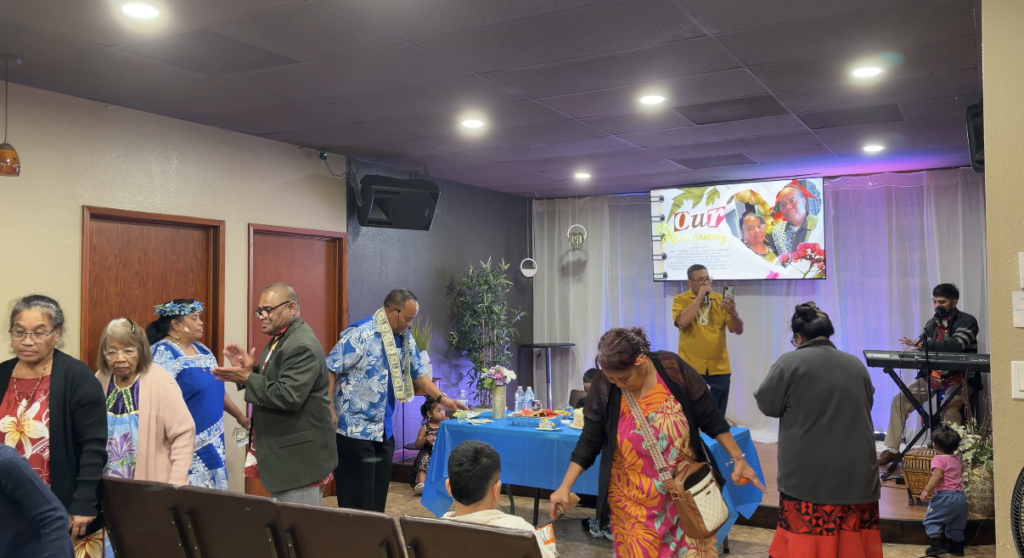
They are Marshallese, a people from the Marshall Islands — known by many Americans for the atomic bomb testing by the United States from 1946 to 1958.
I share a part of this lineage.
5:30 p.m. My mom and I arrived 30 minutes after the official start time, because we know island time, meaning there isn’t really a start time.
Not well enough. The second time around, I thought I had learned and arrived an hour later. Still wasn’t late enough.
This is one of three Marshallese churches in San Diego. It formed three years ago, after Pastor Houston Mito left the Assembly of God denomination, to start a new church under a Pentecostal denomination called “Kituan Jitub Kojarjar,” shortened to “KJK,” which means “breath of the living Holy Spirit” in Marshallese. According to a study by Pew Research in 2024, 1% of the San Diego metropolitan area identify as Pentecostal.
The Marshall Islands is majority Christian, with Protestant being the most common denomination, practiced by more than half of the population, according to a study by the U.S. Department of State in 2021.
The KJK strongly believes in the power of the Holy Spirit, speaking in tongues and divine healing. There are at least 40 KJK churches in the nation, according to Mito, who said that was the amount at a church conference he attended in Oklahoma earlier last month. It is the only KJK congregation in San Diego.
That Sunday evening, my mom and I pulled into the parking lot, where we saw only two cars. We weren’t sure if we were in the right place until we saw familiar Marshallese faces. It was Mito, another pastor, their wives and three children.
The room fit seven rows of five chairs. Where the pastor stood was a patterned rug, a keyboard to his left, plants on either side, a TV behind him and a pulpit that had a cross and the name “Jesus.” A box of tissues rested on it.
6:13 p.m. My mom and I chatted with the pastors, took our seats and waited. More members arrived — one with a watermelon.
Ten minutes later, the service began. In Marshallese culture, it’s tradition to greet one another with a delicate handshake, and a “Iakwe,” a greeting in Marshallese, and share your name if you didn’t know the other person.
Going to church and speaking the language are two of the ways the Marshallese maintain their culture in San Diego. Mito’s wife, Yolandina, said they pass down certain manners to their children as another way to keep the culture.
A major one is modesty. “Nothing over your knee,” she said.
The women at church wore dresses to their ankles, called mumus, with bright colors and patterns. Most of the couples wore traditional matching outfits.
Yolandina noted that there are many cultural differences in San Diego, so maintaining traditional customs can be difficult.
“Our job as a parent, we keep trying to just teach [the kids], you know, remind them our custom,” she said.
6:50 p.m. An hour and 20 minutes in is typically when other church services are ending, but this is when Mito opened the service in prayer. He introduced my mom and me to the church. More people rolled in. More at 7:10, then 7:17 — over two hours past 5 p.m., the official start time. A baby ran around the room.
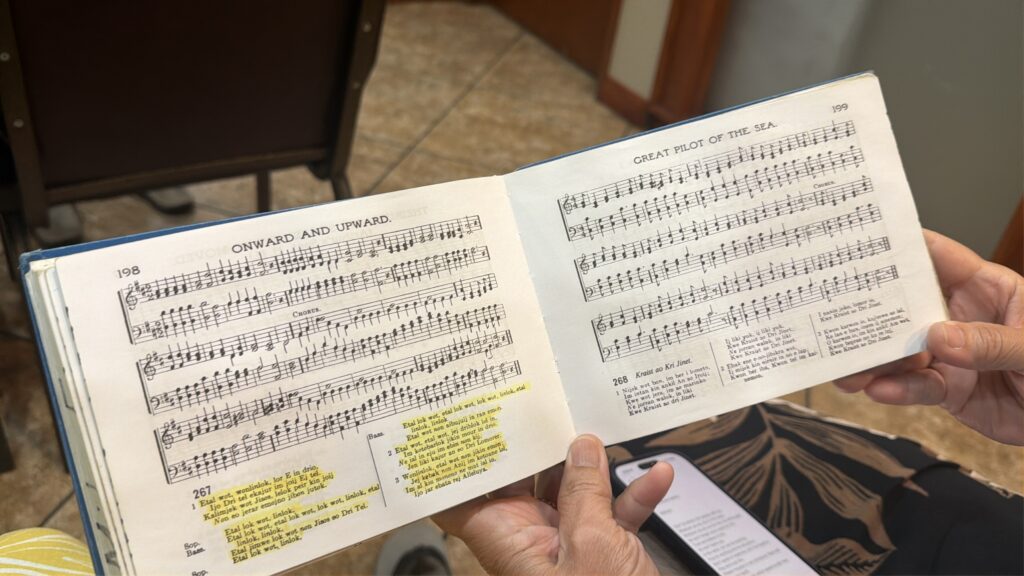
They spoke in Marshallese. I sat close to my mom as she translated for me. She didn’t teach me the language when I was a child because she didn’t like my accent, she said. Still, I didn’t feel excluded during the service.
“You’re Marshallese, so you’re always welcome,” Pastor Peter Lorennij told me.
7:20 p.m. During worship, we walked around the room and did a second round of shaking hands with the 10 members. They waved their hands, some paced in the area they were in, praising. They danced, some sobbed. “Jesus, kommol,” many said. “Jesus, thank you.”
“The worship makes me feel more strong,” Lorennij said. “I was feeling the Holy Ghost Spirit. … I didn’t feel it on my island, but over here.”
Dolorina Mito-Jeik, Mito’s daughter, led the worship. She didn’t stand on the stage, like most churches have worship leaders do. She was off to the side, out of sight. The pastor remained on stage, praising with eyes closed and hands in the air.
“I know that I didn’t give myself this talent, so I got to give credit to God,” Dolorina said. “One thing that I’m very thankful for in the community, in the Marshallese culture, is we know how to give thanks to God. … He’s the reason for everything.”
7:30 p.m. After worship, the church leaders set up a Zoom meeting with an Arizona church, also KJK, for a budget meeting. They were planning their funding for a church conference in Oklahoma, which they attended earlier in March.
A budget meeting isn’t typical for their Sundays.
8:13 p.m. My mom and I were introduced a second time to members who arrived later. Mito asked me to share a part of my story with the church about how I’m on a journey to learn my culture.
I shared with them that I grew up in a small town in central California. While my mom was born and raised in the Marshall Islands, she didn’t teach me the culture. It wasn’t until I attended Marshallese gatherings in a nearby town that I became curious to know more.
8:25 p.m. Mito preached a sermon on trusting God and being fearless in your faith. He was emotional — I soon realized why there was a box of tissues on the pulpit.
“What I like about pastoring the most is you have to study. … So that way, when you preach, you got to make sure people understand what you’re preaching,” he said. “People are united together, come in oneness, you know? One heart, one soul, everybody’s happy.”
9 p.m. The message was followed by more singing. While I did not understand the words, I witnessed their excitement and passion. They danced around the room, waved their hands and cried to Jesus.
“This is what we do,” church member Sylvia Mito told me, as she grabbed my hands and we danced.
“It’s kind of like sanctuary for everyone,” Sylvia said. “The people here are really nice. … Every Sunday we go to church; it feels good. [Her church doesn’t] believe in nothing but God — one God.”
10:30 p.m. I normally would be in bed winding down for the night. But we were getting ready for a party. Members moved a table to the front, and Mito and Yolandina sat down with a cake. They were celebrating their wedding anniversary. We ate pizza, watermelon and other snacks for dinner.
10:47 p.m. We danced and sang for a while more. We exchanged more handshakes and talked.
11:30 p.m. Six hours after we arrived, we left, as a few islanders continued to socialize and dance.
“You just can’t explain that to someone who isn’t Marshallese,” my mom said.

 Belen Palomino Young