
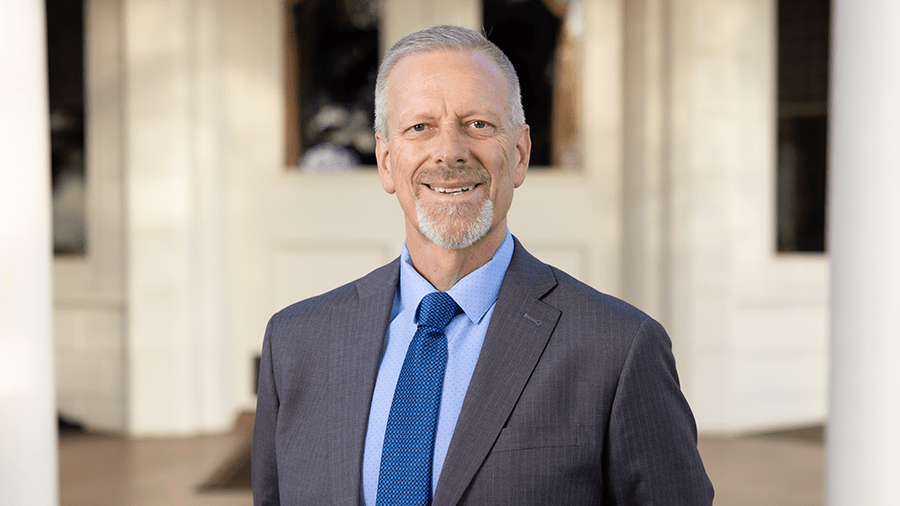
As the school year concludes, Point Loma Nazarene University President Kerry Fulcher wraps up his second year in the office.
The 2025-26 school year presented challenges both worldwide and on campus. From Charlie Kirk’s assassination and Turning Point USA being denied as a campus club, to the federal government shutdown, war and immigration, the PLNU administration has had to navigate complicated decisions.
Much of the weight fell on Fulcher, who was previously PLNU’s university provost and chief academic officer, which is who acts as the bridge between faculty and the president.
The Point conducted an interview with Fulcher to reflect on this year’s challenges, successes and goals as university president. To accommodate Fulcher’s schedule, the interview was conducted through email.
The Point: You’re wrapping up your second year as university president. How are you feeling?
Kerry Fulcher: I feel optimistic and aware of the weight of the role. There are days when the pace is relentless and you’re moving from one decision to the next … you feel the weight of trying to lead well in a moment that’s not always clear or predictable. But what stands out more than anything is the people. Any time I’m with students, faculty, or staff, I’m reminded of why this place is so special.
TP: What has been your favorite part or a highlight?
KF: My favorite moments are always the ones where I get to engage with students. A lot of this role is filled with meetings, travel, and the ongoing demands that come with leading a university. But when I’m at a campus event, I get to see students as they really are. You see their growth, their questions, their sense of calling starting to take shape. Those moments remind me of what all the work we do is actually for.
TP: This year was a bit chaotic since the first weeks of the fall semester, with national news and how PLNU responded to Charlie Kirk’s assassination and TPUSA’s denial as a campus club. As this year concludes, what are some things you have been reflecting on? What are some changes PLNU will undergo or reconsider in the next year?
KF: There were a few points this year where you could really feel the weight of what we were navigating as a campus. In those moments, it was clear that the tensions we see in the broader culture were showing up here in real ways. It reinforced the importance of how PLNU responds with intention and clarity. Not avoiding hard conversations, but also staying grounded in who we’ve always been and will continue to be as a Christ-centered community.
One of the decisions we made was to pause the student club application process so we could step back and take a more thoughtful internal look at how those structures are serving and representing students. Additionally, we conducted an external review to see what we could learn from other universities like ours.
As a result of these reviews, the university administration has clarified that recognized student organizations must be fully student-led and operate independently within our campus community, rather than serving as formal affiliates or chapters of external organizations. The student club application process will relaunch this fall, as we committed, with the goal of providing a clearer, more consistent path for student involvement.
TP: In a Q&A you did with The Point last year, you said the hardest part of transitioning from provost to president was managing an ever-changing schedule. Where are you with that now?
KF: There are days when you move from a conversation with a student to a budget meeting, to an event that evening, all within a few hours. It keeps you on your toes. What I’ve learned is that instead of trying to control it, you have to learn how to move with it.
TP: In that same Q&A, you mentioned short-term goals of engaging with different groups on campus, attending sports games and listening. Do you think you fulfilled the goals you came into this year?
KF: There are days when you look up and realize your whole day is already full before it even starts, and you missed opportunities to be at something you care about. At the same time, there have been moments where I’ve been able to show up to a game or an event and just be there, and those are always worth it. … I want to keep getting better at creating space to show up, to listen, and to be part of what students are actually experiencing day to day.
TP: Where are you with your long-term goal of finalizing the cabinet team and the OnePLNU strategic plan?
KF: We’ve made good progress, but there’s still some work to do. On the leadership side, we’re in the middle of a few key searches to round out the cabinet … It’s important to me that we have the right people in place who not only bring strong experience but are aligned with who we are as a university.
With OnePLNU, we’re continuing to build on that … One example is Shaping Tomorrow’s Academy. We’re taking a close look at how learning happens here, making sure we’re not just keeping up with change, but responding to it thoughtfully. That means rethinking how we design programs, how we connect learning to real-world needs, and how we help students develop a clear sense of vocation, all while cultivating a vibrant Christian intellectual life.
TP: What is your goal or mission for the campus community moving into your third year?
KF: I’ve been thinking a lot about the kind of community we want to be, especially in a time where so much around us feels divisive. My hope is that PLNU is a place where students can wrestle honestly with real questions, about faith, about purpose, and about the world they’re stepping into, and do that in a community that takes both truth and grace seriously.
We don’t have to avoid hard conversations, but we can approach them differently. With humility, with respect, and with a willingness to listen well. That’s part of what it means to be a Christ-centered community. … My hope is that students leave here not just well educated but well formed. Grounded in their faith, clear in their calling, and prepared to lead in a way that reflects both conviction and care.
TP: Is there anything you want the community and beyond to know?
KF: I would just say how grateful I am to be part of this community. … There’s a genuine care here, a sense that what we’re doing matters, and that we’re part of something bigger than ourselves. … We have an opportunity to bring something different, something steady, thoughtful, and rooted in who we are.
You’ll hear more about this in the year ahead, but I think it connects to a simple idea: the kind of light we bring into a room, into a conversation, into someone’s life. That is our shared calling: to become people who do not simply reflect the world as it is, but help illuminate what it can become.

 Emily Jones
  Grace Chaves