

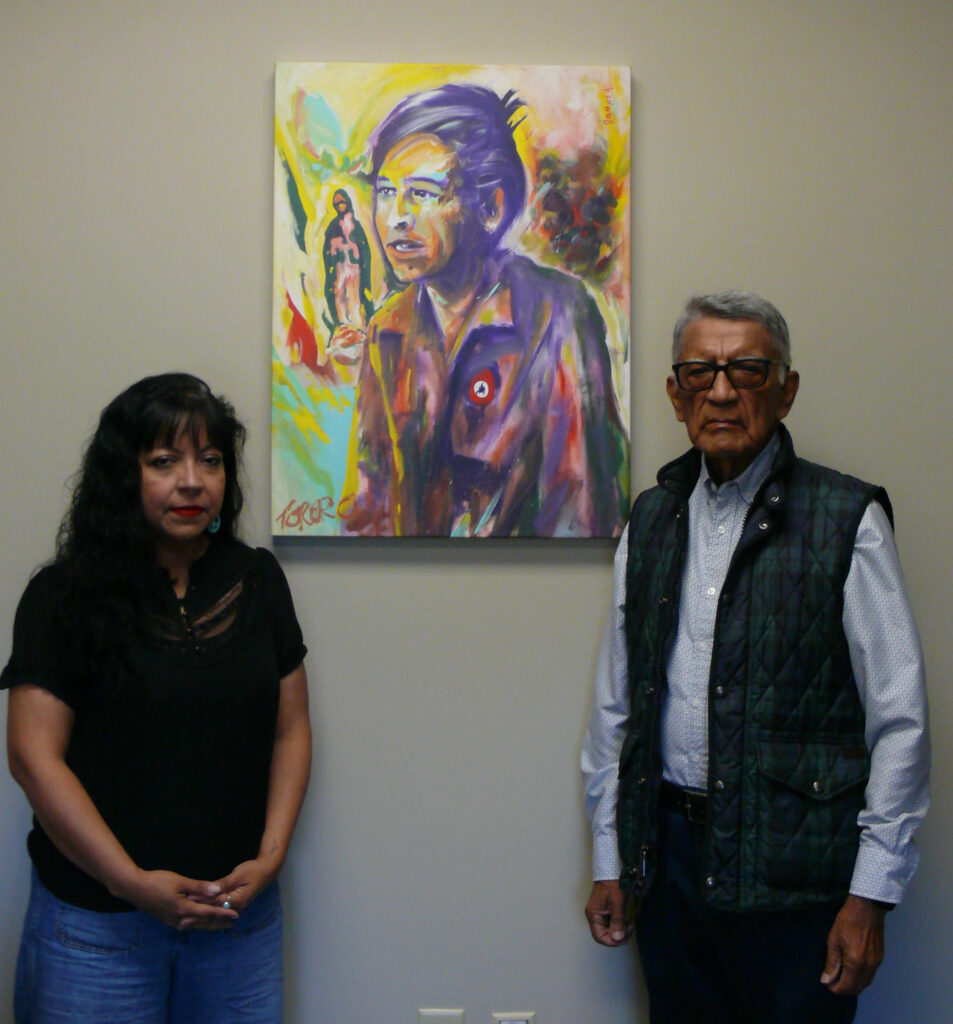
Editor’s Note: Rev. Jonathan Salgado is a theologian and educator who earned his master’s in religion from Point Loma Nazarene University in 1973. He has served as a pastor, professor and across continents, and was the founding president of Nazarene Theological Seminary in Guatemala. He is currently coordinator for Spanish initiatives for the Center for Pastoral Initiatives at PLNU and continues to teach and collaborate with institutions internationally.
Rev. Marshela Salgado serves as executive minister at University Christian Church in San Diego and on the board of The Center for Progressive Theology. A graduate of PLNU (2001), she has developed educational and faith formation programs for churches and nonprofits. She is passionate about accompanying marginalized communities and fostering collaboration across neighborhoods.
Jonathan Salgado:
I grew up in a Quaker home, where faith was not just something we believed. The values of equality, nonviolence and justice were not abstract ideals; they were embodied in everyday life. That formation shaped my calling as a minister.
As a Reverend, I began my ministry during the social upheaval of the 1960s and 70s — a time when questions of justice were urgent. As a conscientious objector and a pastor, I understood my role as leading a congregation and walking with people in their struggle for dignity.
It was in that context that I first encountered César Chávez and el movimiento.
Working among migrant farmworkers and in prisons, I witnessed firsthand poverty, exploitation and discrimination. As a Latino minister, I could not separate my faith from the lived experiences of my community.
I admired what Chávez represented. It was never about one man. It was about people rising, organizing, sacrificing and believing that a more just world was possible.
When I met Chávez during his visit to Idaho, I saw a symbol of that collective struggle. In my role as a minister, I invited others — students, church members and community leaders — to pay attention and to stand in solidarity with farmworkers. Many responded. Some resisted.
I remember one Sunday, after worship, a parishioner pointed at me and said, “This pastor must be dismissed; he’s a communist!” At the time, I did not take it personally. Compared to the persecution faced by leaders like Chávez, Martin Luther King Jr. or Nelson Mandela, it seemed small. But it revealed something deeper — how often the church struggles to recognize the gospel when it shows up in the fight for justice.
And yet, I remained convinced then, as I am now, that the church is called to more. Called not to just observe movements like this from a distance, but to stand within them. Called not just to preach about justice, but to embody it.
Those years left me with questions — questions about faith, power, and human nature. And now, those questions return with renewed urgency. Because now, I am confronted with a painful truth: one of my heroes caused harm.
Marshela Salgado:
I was raised on those same values. Chávez was not just a historical figure in our home — he helped shape how I understood justice and community.
Growing up, I didn’t learn much about César Chávez in school. It was my father’s firsthand accounts and stories that shaped my understanding of him. It wasn’t until college that I came to understand his significance more fully.
I immersed myself in that work — organizing, advocating, and building community. I helped lead interfaith efforts connected to the César Chávez Day of Service, working alongside civic leaders, activists and members of Chávez’s own family. His legacy — his values of service, sacrifice and nonviolence — aligned with my faith and my life.
Like so many stories in history, the narrative centered one man, while the labor of women remained in the background. Dolores Huerta, co-founder of the United Farm Workers, strategist, organizer and the voice behind “¡Sí, se puede!,” was treated as secondary in a movement she helped build.
This week, many of us felt something break. The revelation that César Chávez sexually abused women — including Dolores Huerta and young girls — has shaken our sense of trust. For those of us connected to el movimiento, this is not just historical, but deeply personal.
Because when someone we have lifted up falls, it doesn’t just challenge the past — it challenges us.
And yet, something else happened this week. People listened. People believed survivors. Institutions, including the César Chávez Foundation, acknowledged the harm and made clear that the movement was never meant to stand on one man. That matters. Because too often, when harm is revealed, communities rush to protect legacy over people. This moment has shown another way.
And still, we must be honest: Even in our most progressive spaces, women are too often treated as disposable. When they come forward, their stories are questioned. Their timelines are scrutinized. Their pain is weighed against the comfort of institutions.
The question, then, is not only about Chávez. It is about us. Why do we so easily center individuals instead of movements? Why do we protect people in power? Who are we protecting right now? And why?
For those of us shaped by the Christian story, this moment calls us back to something essential. In the gospel of Luke, it is women who are the first to witness the resurrection, the first to proclaim hope, the first to carry the story forward. That is not incidental. It is foundational. Honoring women is not an addition to faith or justice work — it is at the very heart of it.
We do not honor movements by protecting their heroes at all costs. We honor them by telling the truth, by refusing silence, by choosing people over power. And it means asking harder questions: Where are we still protecting systems that harm? Where are we still hesitant to believe? Where are we being called to change?
The truth is, movements have never belonged to one person. They are carried forward by communities.
Huerta’s voice, and the voices of other survivors, remind us that the work of justice has always depended on people willing to speak truth.
So this moment is not just about reckoning with the past. It is about choosing who we will be moving forward.
Will we protect power? Or will we protect people?
Will we cling to comfort? Or will we choose courage?
Because the measure of our values is not what we say when things are easy. It is what we do when the truth is hard.

 Nathan Gibbs