

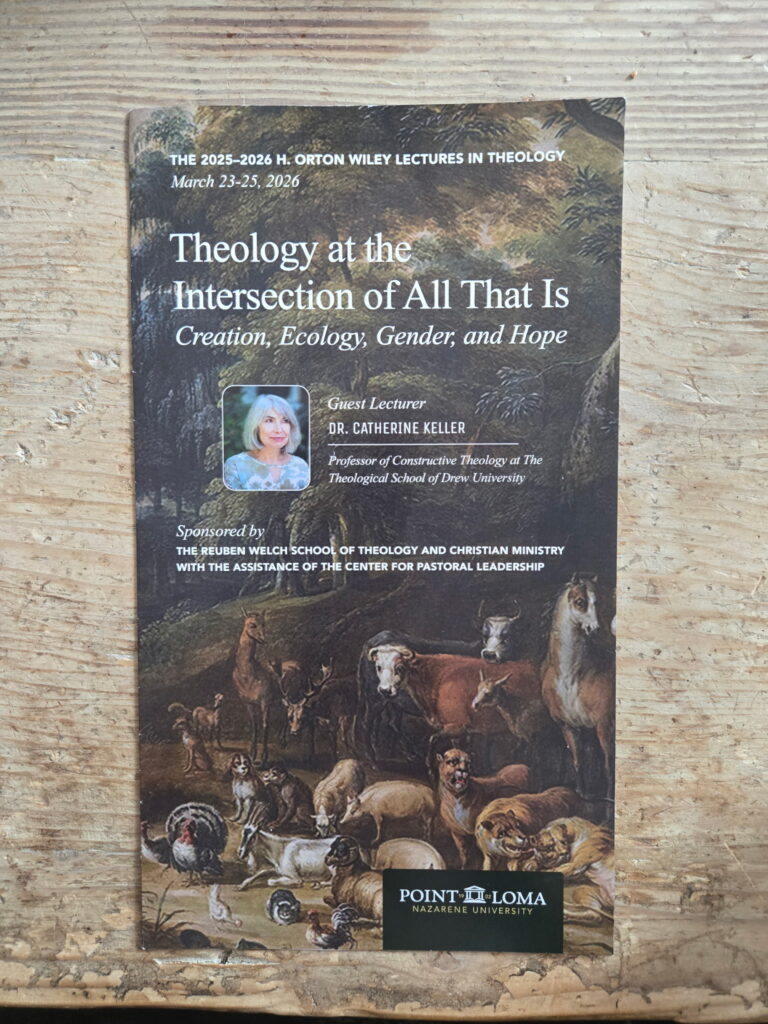
Students arrived at Crill Performance Hall ready to learn, listen or simply be marked present for class attendance at that time. A room where band concerts and orchestra performances are normally held became the place where this year’s Wiley Lecture Series came to life. Founded by H. Orton Wiley in 1951, this year’s guest speaker was Catherine Keller.
As a professor of constructive theology at the Theological School of Drew University, Keller spoke about the intersection of creation, ecology, gender and hope.
According to Brad Kelle, Point Loma Nazarene University’s interim dean of theology and Christian ministry, Keller is “probably the most important philosophical theologian in the world at present.”
Keller’s first lecture was titled “Creation: Cosmos, Connection, Creativity.” In this lecture, she discussed “process theology,” a theological and philosophical concept based on Alfred North Whitehead’s work in which he views the world in a constant state of change as opposed to a static reality.
Keller explained how, in process theology, there is a responsive God who reacts to humanity. She said this goes hand in hand with viewing creation as not having been created, but rather becoming. Keller said that God’s creation is still in the process of being created today.
Michael Lodahl, professor of theology and world religions at PLNU, said that this first lecture was his favorite part of the series.
“[My favorite part was] her encouragement that we not think of creation as a past thing, no matter how far back we might want to think it, and really begin to think way more about what’s happening right now, and especially in interactivity,” Lodahl said. “Unless we have a doctrine of creation that really embraces and tries to engage this reality right here, it’s not a very good doctrine of creation.”
Keller, continuing her theme of intersectionality, later talked about the interconnectedness of not just humans with each other, but humans with the earth. She spoke about how harming the earth is harming our spirits. She continued to explain this concept in depth in her second lecture about ecology, and again in her fourth lecture about hope.
Keller’s second lecture, “Ecology: What’s Coming?,” was about the responsibility humanity has to reverse the damage that has been done to the earth. In her fourth lecture, “Hope: Embracing Planetude,” Keller talked about how as Christians, people should not be hopeful but not blindly optimistic or despairingly hopeful when it comes to ecology. But it was the third lecture, “Gender: Tangles of Sex, Bodies, Politics,” that grew to be a prominent point of discussion on PLNU’s campus, as Keller discussed the entanglement and interconnected web between the human body and gender.
Students took to Fizz, anonymously complaining about Keller, saying that she was too
“woke.” One student asked, “Did anybody actually like the Wiley lectures?”
Lodhal said that he believes that using the term “woke” as a derogatory term is ludicrous.
“Woke means to me, being awakened to the very kinds of things [Keller was] talking about, which means being attentive to the world we live in and its differences and diversities,” Lodahl said.
Heather Ross, associate professor of philosophy at PLNU, said that students don’t have to agree with everything they’re learning, but they do need to take these ideas seriously.
“It is rare that I listen to any lecture, and especially any theological lecture, and fully affirm everything that is claimed or imagined,” Ross said. “This is not the point of listening to a lecture. I am there to learn, to ask robust questions, and to think seriously about serious matters. How wonderful is it that a good chunk of our student body and community at large are thinking seriously about questions of Christian orthodoxy, about questions about the power of God, about salvation and responsibility for the gift of creation.”
Seamus Pilette, a third-year business and philosophy double major, echoed this and said that he thinks the lecture series is important for students to become more open-minded.
“A big point of the Wiley lectures is to introduce a perspective that is not something most of the student body would see,” Pilette said. “If we invited a conservative theologian, that wouldn’t be injecting much uncomfortability [in] an intellectual sense. … [The point of a lecture] is to be challenged.”

