
Editor’s Note: Lux Coker is a fourth-year international development major. She plans to pursue a career in poverty alleviation and global economics after graduation, driven by a commitment to advocate for and stand with communities that have been historically marginalized. Whether through supporting nonprofits that serve those on the margins or engaging in institutional reform on a global scale, she is committed to advancing equity, sustainability and human dignity.
I began participating with Point Loma Nazarene University’s Ministries with Mexico (MWM) in the fall of 2024, during a difficult season in my life. I tend to turn to service in hard times, and MWM was something I had been intrigued by, so in that moment, any hesitation I once had was washed away.
While I have frequently attended Saturday trips, this was my first Border Pilgrimage. Beyond my concern for humanitarian rights and aid, everything happening in the United States and the treatment of human beings at the border created an urgent desire to witness it firsthand.
We left early afternoon on Feb. 7, stopping first at Chicano Park, where we observed art and learned about the history of border communities. We also visited Our Lady of Guadalupe Church, where we heard about their longstanding practice of sheltering migrants and what that looks like in the current political climate.
Before crossing into Mexico, we stopped at the W-8 border site and listened to a man who had been involved in providing resources for those stranded between the U.S.-Mexico border during the most recent crisis.
We heard stories of families separated, men held at gunpoint, bodies found lifeless in the space
between the two walls and a 12-year-old boy who fell from the wall and was left paralyzed.
We saw photographs of fathers grasping their children’s hands through rigid bars and images of
tents and tables set up as fragile sanctuaries that kept people barely surviving.
We were given time to sit with the wall and reflect, standing beside the remnants of aid, documents, tables and coils of barbed wire discarded in a nearby dumpster.
While these stories are not entirely new to me, the empathy and desire to act never diminish. This is not an issue we should ever grow numb to.
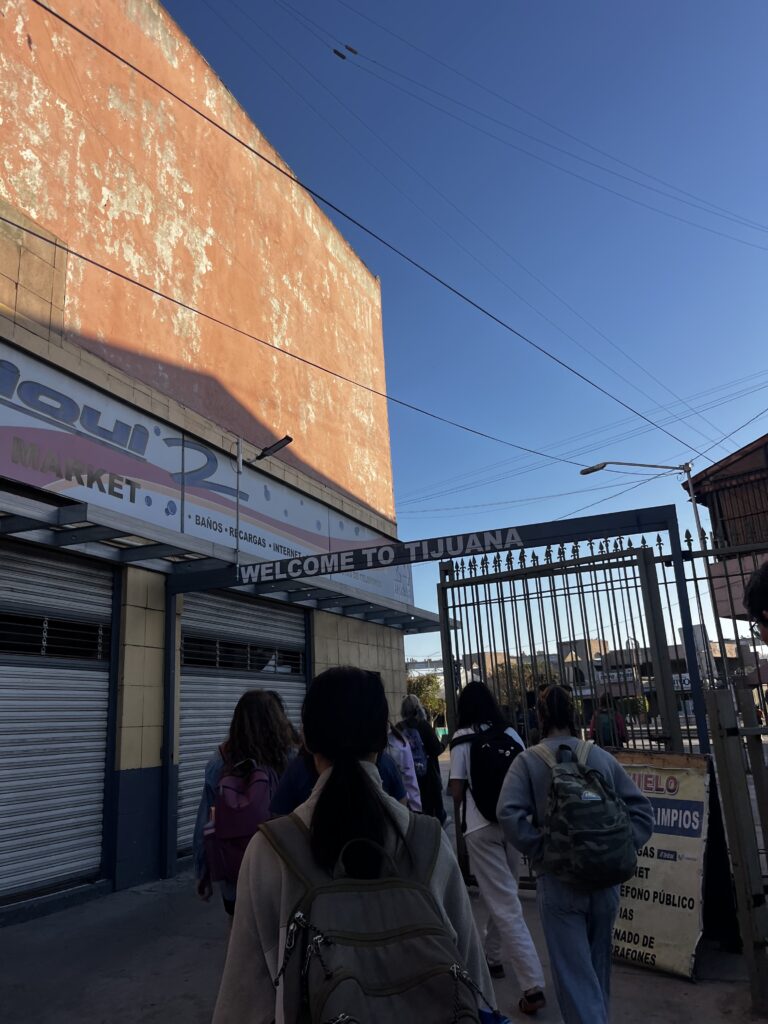
After W-8, we walked across the border into Tijuana and made our way to Casa del Migrante,
where we stayed alongside 63 recently deported migrants. At the shelter, residents are provided
with meals, psychological care and resources to help them regain stability and dignity. We shared dinner with them, built connections and listened to stories that allowed us to step into shoes we could never comprehend walking in. Some had lived in the United States for decades before being deported — uprooted from the only life they knew and forced to begin again.
Occupying space in the shelter felt both like a privilege and a tension. We were visitors; this was
their reality. It was a heavy time of reflection, and MWM Director Jeffrey Jimenez created
intentional spaces for us to process together that evening and the following morning. As a group,
we unpacked what we had experienced, and some shared personal immigration stories of their own. This is not a distant issue; it affects our peers on this very campus.
After leaving the shelter, we stopped for coffee and lunch before heading to Border Church, which gathers where the wall meets the sea. The service takes place on both sides of the border,
connected by a television screen. On our side, the wall was vibrant with colorful murals painted
by deported artists. There was a tangible sense of joy and hope in the air.
We took communion and worshiped together, united in faith in the same God. Yet I felt a
heaviness, recognizing that while we stood there with passports in our pockets, they were praying for forgiveness of sins our country, which we would soon return to, had committed.
After the service, we explored the beachside market before beginning our walk back to San
Diego. As we stood in line, we passed vendors selling handmade crafts and food, children
seeking shade beneath the structure of the crossing, and families playing music while extending
plastic cups for donations. We passed by their offerings with gratitude and shared what snacks
we had left with the children we encountered.
While there may be miles between daily life in the United States and the border wall, life in
Mexico begins the moment you step across that drawn line. It is a life that is valuable, vibrant,
resilient and full of hope. It is a life I am continually humbled and grateful to experience.

 Olivia Roberts