
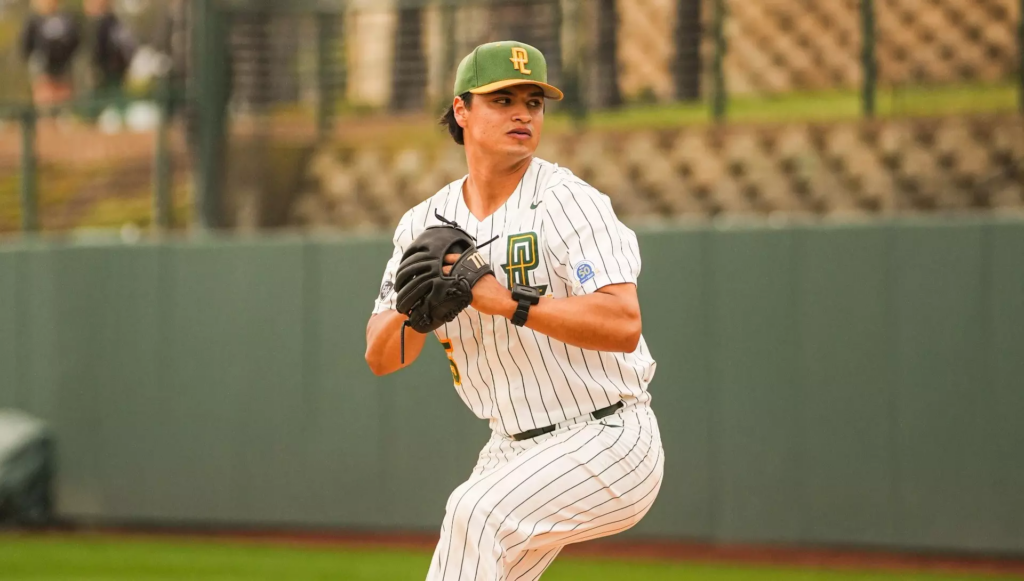
Another Point Loma Nazarene University baseball alumnus signed with a Major League organization, the Seattle Mariners. Pitcher Ray Cebulski, who played three seasons at PLNU, signed a minor league contract with the organization and was promptly assigned to the Arizona Complex League.
Cebulski started 39 games and pitched to a 4.71 earned run average, notching 167 strikeouts along the way. In each of his three seasons in green and gold, he was top three in innings pitched, serving as a steady arm for the Sea Lions to rely on. Cebulski was a key contributor to the 2024 team that made a Division II College World Series run.
After graduating in 2025, Cebulski moved to Phoenix, Ariz., to train at the Driveline facility. Driveline is an organization that trains up-and-coming players through data and analytics-based training.
The Point talked with Cebulski about his ascent as a player, his time at PLNU and what the future looks like as a professional player.
The Point: When did you realize that baseball was something you wanted to pursue as a career at the professional level?
Ray Cebulski: I’d say when I was growing up, like 8 years old to 12 years old, I always knew I wanted to go play a college sport, whatever that was. I was obsessed with college football. I’d watch that every Saturday, and then I kind of realized, like, hey, these kids have scholarships and are able to help their family out by playing a sport. … That was something I wanted to do, play college sports and get an education.
TP: How did you find out about Point Loma and get recruited by them? What was the process of going to Long Beach State for a year and then deciding to come to Point Loma?
RC: I learned a lot my freshman year of college. I think I was one of the youngest guys on the staff and one of the only freshmen on the pitching staff throughout the year. I ended up having my scholarship reduced at the end of the year, and the coach kind of wanted to go a different way. So I was like, you know, I’m going to hit the portal. … Once I hit the portal, like 10 minutes later, Point Loma was calling. I was super grateful for that. This was a good spot for me to get a really good education, and that went a lot into it.
TP: What was the most important thing you gleaned from your Point Loma baseball career?
RC: I think the group of guys I got launched into that first year, coming off a College World Series push. … I think the brotherhood and quality of guys that Point Loma brings in every year is really impressive. And I get to go and say I have 30 brothers that I can go call at any given moment … it’s like a brotherhood that you can’t really get anywhere else. … I think those relationships, on and off the baseball field, just help tremendously in the process of being a college athlete and what you actually think about when you reflect on it all.
TP: Is there a particular moment that you’re going to remember most from your Point Loma career?
RC: ‘24 was a big one. That was a special, special squad … making the World Series, especially, is our biggest goal, you know, and those are truly special times.
TP: What’s your day-to-day process been like since signing with the Mariners?
RC: Definitely a lot of uncertainty, going out here and taking a shot. The Mariners reached out even after the draft. That was in June, July-ish. I was kind of thinking about walking away from the game. Not in a bad way, but understanding what had to go into it. Them reaching out kind of fired me up again. … Having a team kind of believe in you and be like, ‘Hey, like, we’re close and having a couple conversations saying we might, we might be doing this.’ I was like, ‘Dude, I got to keep going, man.’ So I came out here [Arizona] to train at Driveline, and I was working part-time at Flower Child. I just worked at the restaurant, trying to pay the bills and then train my a** off in the morning, five to six times a week. So that was kind of a daily grind.
TP: Would you say there was a person who was especially instrumental in your growth as a player?
RC: I spent a couple years at Point Loma with Caden Lewis, who was a left-handed pitcher. … We were together for three years. We transferred in together, and he has a really good baseball mind, and being one of my best friends, too, kind of helped when we were out there competing hard against other teams. I can talk to him. He can talk to me and be completely straight up with what he’s seeing, what I’m seeing, and we can kind of talk to each other, and he can help me zone back in in a high-intensity moment because we are so close.
TP: As a pro now, how’s your schedule and routine going to start changing soon?
RC: I haven’t got my report date yet [for Spring Training], but it’s either February 20 or March 1, so I’m going to continue to be here, training at Driveline, gearing up. Thankfully, I’m out here, so Peoria is pretty close. I get to just stay at Driveline Phoenix and continue to get ready for Spring Training, which is pretty exciting.
TP: Are there any goals that you have your sights set on right now? What do you have in the back of your mind to keep yourself focused and motivated to keep going?
RC: Well, of course, I mean, I love it now, that being a pro guy, it’s all, it’s up to you. It’s your career. So whatever decisions I make on a day-to-day basis, the work you put in, it all reflects upon you. So I just try to consistently be as best as I can be every day and understand that I’m given an opportunity of a lifetime, and I just want to maximize each day and go out there and compete. It’s pretty simple. Trust in the work I’ve done and go out there in Spring Training, try to earn a job.

 Denzell Washington